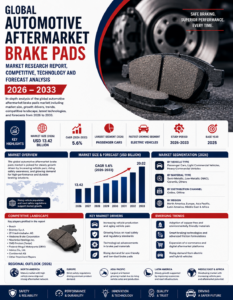
According to Market Research Point’s in-depth analysis, the global Automotive Aftermarket Brake Pads market was valued at USD 7,854 million in 2026 and is projected to reach USD 9,760 million by 2033, expanding at a CAGR of 3.15% during the forecast period (2026–2033).
According to Market Research Point’s in-depth market analysis, the global Automotive Aftermarket Brake Pads market was valued at USD 7,854 million in 2026 and is projected to reach USD 9,760 million by 2033, registering a CAGR of 3.15% during the forecast period (2026–2033). The China Automotive Aftermarket Brake Pads market has experienced significant development in recent years. By 2026, the Chinese market is expected to reach USD Million, accounting for approximately % of the global market share.
This report provides a comprehensive analysis of the global Automotive Aftermarket Brake Pads market, with a dedicated focus on major countries and the Chinese market. It presents historical market data from 2021 to 2025, considers 2026 as the base year, and delivers market forecasts from 2027 to 2033. The report examines sales volume, revenue, pricing trends, market share, gross profit, and production performance of leading manufacturers across key regions. It also evaluates competitive developments and provides detailed market segmentation by manufacturer, product type, application, and geography. The report is designed to help manufacturers, investors, industry participants, and new market entrants understand current market conditions, identify growth opportunities, and support strategic business planning.
From a regional perspective, the report covers North America, Europe, Asia Pacific, Latin America, and the Middle East & Africa, providing detailed insights into market size, growth potential, competitive dynamics, and emerging opportunities across these regions. It also evaluates the influence of government regulations, economic conditions, and technological advancements on regional market development, enabling businesses to formulate effective expansion and investment strategies.
The research findings are supported by data collected from a wide range of reliable and authoritative sources. Macroeconomic information is obtained from national statistical agencies and international economic organizations, while industry-specific data is sourced from recognized trade associations and market institutions. Company information is compiled through publicly available financial reports, corporate publications, industry interviews, and trusted third-party databases. Pricing information is gathered through comprehensive market monitoring systems. By integrating and validating data from multiple sources, Market Research Point ensures that the report delivers accurate, objective, and actionable market intelligence.
The report profiles the following key companies:
BOSCH
ZF Aftermarket (TRW)
TMD Friction (AEQUITA)
Tenneco (Federal Mogul)
ITT Corporation
MAT Holdings
Hitachi
Nisshinbo
Sangsin Brake
ADVICS
Shandong Gold Phoenix
GM (ACDelco)
Brake Parts Inc.
BorgWarner (Delphi)
Fras-le
Akebono
Continental (ATE)
Brembo
ABS Friction
Icer Brakes
FBK
MK Kashiyama
EBC Brakes
Yancheng Fangtian Autopart
Based on product type, the market is segmented into:
Ceramic
Semi-Metallic
Low-Metallic NAO
Others
Based on application, the market primarily covers:
Commercial Vehicle
Major regional markets analyzed include:
US
Europe
China
Japan
Korea
India
Southeast Asia
South America
The report is organized into five major sections comprising ten chapters:
Part One – Foundation (Chapter 1): Introduces the Automotive Aftermarket Brake Pads market, including product definition, market overview, product characteristics, product types, application analysis, and industry value chain.
Part Two – Global Market Analysis (Chapters 2–4): Presents a detailed assessment of global market size, sales volume, demand, production, and growth forecasts across different product categories and application segments.
Part Three – Regional Market Analysis (Chapters 5–6): Examines market performance, production, consumption, revenue, and future growth prospects across major geographic regions.
Part Four – Competitive Landscape (Chapters 7–8): Profiles leading Automotive Aftermarket Brake Pads manufacturers, covering company overview, product portfolio, technologies, business strategies, sales performance, revenue, market share, and competitive positioning.
Part Five – Market Outlook (Chapters 9–10): Evaluates the industry’s operating environment, emerging opportunities, market challenges, potential risks, and long-term development outlook to support informed strategic decision-making.
-
-
Market Overview
1.1 Product Introduction, Application, Picture
1.2 Global Automotive Aftermarket Brake Pads Market by Value
1.2.1 Global Automotive Aftermarket Brake Pads Revenue by Type
1.2.2 Global Automotive Aftermarket Brake Pads Market Share by Value (%)
1.3 Global Automotive Aftermarket Brake Pads Market by Production
1.3.1 Global Automotive Aftermarket Brake Pads Production by Type
1.3.2 Global Automotive Aftermarket Brake Pads Market Share by Production (%)
-
Market Drivers and Industry Analysis
2.1 Historical and Forecast Global Automotive Aftermarket Brake Pads Demand (2021–2033)
2.2 Major Application Analysis of Automotive Aftermarket Brake Pads
2.3 Key Downstream Companies in the China Market
-
Global and Regional Market Analysis
3.1 Regional Market Size by Production and Demand (2026)
3.2 Regional Market Share by Revenue (2026–2033)
3.3 Market Concentration Analysis (CR5 & CR10)
3.4 Mergers, Acquisitions, and Expansion Strategies
-
United States Market Analysis (2021–2033)
4.1 Production Analysis by Type
4.2 Demand Analysis by Type
4.3 Demand Analysis by Application
4.4 Revenue Analysis by Type
4.5 Revenue Analysis by Application
-
Europe Market Analysis (2021–2033)
5.1 Production Analysis by Type
5.2 Demand Analysis by Type
5.3 Demand Analysis by Application
5.4 Revenue Analysis by Type
5.5 Revenue Analysis by Application
-
China Market Analysis (2021–2033)
6.1 Production Analysis by Type
6.2 Demand Analysis by Type
6.3 Demand Analysis by Application
6.4 Revenue Analysis by Type
6.5 Revenue Analysis by Application
-
Japan Market Analysis (2021–2033)
7.1 Production Analysis by Type
7.2 Demand Analysis by Type
7.3 Demand Analysis by Application
7.4 Revenue Analysis by Type
7.5 Revenue Analysis by Application
-
India Market Analysis (2021–2033)
8.1 Production Analysis by Type
8.2 Demand Analysis by Type
8.3 Demand Analysis by Application
8.4 Revenue Analysis by Type
8.5 Revenue Analysis by Application
-
South Korea Market Analysis (2021–2033)
9.1 Production Analysis by Type
9.2 Demand Analysis by Type
9.3 Demand Analysis by Application
9.4 Revenue Analysis by Type
9.5 Revenue Analysis by Application
-
Southeast Asia Market Analysis (2021–2033)
10.1 Production Analysis by Type
10.2 Demand Analysis by Type
10.3 Demand Analysis by Application
10.4 Revenue Analysis by Type
10.5 Revenue Analysis by Application
-
South America Market Analysis (2021–2033)
11.1 Production Analysis by Type
11.2 Demand Analysis by Type
11.3 Demand Analysis by Application
11.4 Revenue Analysis by Type
11.5 Revenue Analysis by Application
-
Global Automotive Aftermarket Brake Pads Price Trend Analysis
13.1 US Market Price by Product Type (2021–2026)
13.2 Europe Market Price by Product Type (2021–2026)
13.3 China Market Price by Product Type (2021–2026)
13.4 Japan Market Price by Product Type (2021–2026)
13.5 India Market Price by Product Type (2021–2026)
13.6 South Korea Market Price by Product Type (2021–2026)
13.7 Southeast Asia Market Price by Product Type (2021–2026)
-
Industry Value Chain Analysis
14.1 Automotive Aftermarket Brake Pads Industry Chain Analysis
14.2 Downstream Industry Analysis
14.3 Technology Development Trends
-
Competitive Landscape
15.1 BOSCH
15.1.1 Company Profile
15.1.2 Product Portfolio
15.1.3 Automotive Aftermarket Brake Pads Sales and Revenue
15.1.4 Strategic Developments
15.2 ZF Aftermarket (TRW)
15.2.1 Company Profile
15.2.2 Product Portfolio
15.2.3 Automotive Aftermarket Brake Pads Sales and Revenue
15.2.4 Strategic Developments
15.3 TMD Friction (AEQUITA)
15.3.1 Company Profile
15.3.2 Product Portfolio
15.3.3 Automotive Aftermarket Brake Pads Sales and Revenue
15.3.4 Strategic Developments
15.4 Tenneco (Federal Mogul)
15.4.1 Company Profile
15.4.2 Product Portfolio
15.4.3 Automotive Aftermarket Brake Pads Sales and Revenue
15.4.4 Strategic Developments
15.5 ITT Corporation
15.5.1 Company Profile
15.5.2 Product Portfolio
15.5.3 Automotive Aftermarket Brake Pads Sales and Revenue
15.5.4 Strategic Developments
15.6 MAT Holdings
15.6.1 Company Profile
15.6.2 Product Portfolio
15.6.3 Automotive Aftermarket Brake Pads Sales and Revenue
15.6.4 Strategic Developments
15.7 Hitachi
15.7.1 Company Profile
15.7.2 Product Portfolio
15.7.3 Automotive Aftermarket Brake Pads Sales and Revenue
15.7.4 Strategic Developments
15.8 Nisshinbo
15.8.1 Company Profile
15.8.2 Product Portfolio
15.8.3 Automotive Aftermarket Brake Pads Sales and Revenue
15.8.4 Strategic Developments
15.9 Sangsin Brake
15.10 ADVICS
15.11 Shandong Gold Phoenix
15.12 GM (ACDelco)
15.13 Brake Parts Inc.
15.14 BorgWarner (Delphi)
15.15 Fras-le
15.16 Akebono
15.17 Continental (ATE)
15.18 Brembo
15.19 ABS Friction
15.20 Icer Brakes
15.21 FBK
15.22 MK Kashiyama
15.23 EBC Brakes
15.24 Yancheng Fangtian Autopart
-
Conclusion
-
Research Methodology
-
Figure 1. Total Demand by Application of Automotive Aftermarket Brake Pads Industry (Volume)
Figure 2. Automotive Aftermarket Brake Pads Production and Demand by Region (2026)
Figure 3. Regional Market Share by Revenue (2026 & 2033)
Figure 4. Market Share of the Top 10 and Top 5 Companies by Revenue (2026)
Figure 5. US Automotive Aftermarket Brake Pads Production and Demand (2021–2033)
Figure 6. Production Share by Product Type (%)
Figure 7. Demand Share by Product Type (%)
Figure 8. Demand Share by Application (%)
Figure 9. Revenue Share by Product Type (%)
Figure 10. Revenue Share by Application (%)
Figure 11. Europe Automotive Aftermarket Brake Pads Production and Demand (2021–2033)
Figure 12. Production Share by Product Type (%)
Figure 13. Demand Share by Product Type (%)
Figure 14. Demand Share by Application (%)
Figure 15. Revenue Share by Product Type (%)
Figure 16. Revenue Share by Application (%)
Figure 17. China Automotive Aftermarket Brake Pads Production and Demand (2021–2033)
Figure 18. Production Share by Product Type (%)
Figure 19. Demand Share by Product Type (%)
Figure 20. Demand Share by Application (%)
Figure 21. Revenue Share by Product Type (%)
Figure 22. Revenue Share by Application (%)
Figure 23. Japan Automotive Aftermarket Brake Pads Production and Demand (2021–2033)
Figure 24. Production Share by Product Type (%)
Figure 25. Demand Share by Product Type (%)
Figure 26. Demand Share by Application (%)
Figure 27. Revenue Share by Product Type (%)
Figure 28. Revenue Share by Application (%)
Figure 29. India Automotive Aftermarket Brake Pads Production and Demand (2021–2033)
Figure 30. Production Share by Product Type (%)
Figure 31. Demand Share by Product Type (%)
Figure 32. Demand Share by Application (%)
Figure 33. Revenue Share by Product Type (%)
Figure 34. Revenue Share by Application (%)
Figure 35. South Korea Automotive Aftermarket Brake Pads Production and Demand (2021–2033)
Figure 36. Production Share by Product Type (%)
Figure 37. Demand Share by Product Type (%)
Figure 38. Demand Share by Application (%)
Figure 39. Revenue Share by Product Type (%)
Figure 40. Revenue Share by Application (%)
Figure 41. Southeast Asia Automotive Aftermarket Brake Pads Production and Demand (2021–2033)
Figure 42. Production Share by Product Type (%)
Figure 43. Demand Share by Product Type (%)
Figure 44. Demand Share by Application (%)
Figure 45. Revenue Share by Product Type (%)
Figure 46. Revenue Share by Application (%)
Figure 47. South America Automotive Aftermarket Brake Pads Production and Demand (2021–2033)
Figure 48. Production Share by Product Type (%)
Figure 49. Demand Share by Product Type (%)
Figure 50. Demand Share by Application (%)
Figure 51. Revenue Share by Product Type (%)
Figure 52. Revenue Share by Application (%)
Figure 53. Automotive Aftermarket Brake Pads Industry Value Chain
Table 1. Leading Manufacturers and Market Segmentation
Table 2. Product Introduction, Applications, and Images
Table 3. Automotive Aftermarket Brake Pads Revenue by Type (USD Million), 2021–2033
Table 4. Automotive Aftermarket Brake Pads Production by Type, 2021–2033
Table 5. Automotive Aftermarket Brake Pads Demand by Application, 2021–2033
Table 6. Automotive Aftermarket Brake Pads Revenue by Application (USD Million), 2021–2033
Table 7. Major Downstream Companies in China
Table 8. Regional Market Share by Production and Demand (2026)
Table 9. Regional Market Share by Revenue (2026 & 2033)
Table 10. Ranking of Leading Global Automotive Aftermarket Brake Pads Companies by Revenue and Market Concentration (2026)
Table 11. Mergers, Acquisitions, and Expansion Strategies
Table 12. US Automotive Aftermarket Brake Pads Production, Revenue (USD Million), and Demand (2021–2033)
Table 13. Production Breakdown by Type (2021–2033)
Table 14. Demand Breakdown by Type (2021–2033)
Table 15. Demand Breakdown by Application (2021–2033)
Table 16. Revenue Breakdown by Type
Table 17. Revenue Breakdown by Application
Table 18. Europe Automotive Aftermarket Brake Pads Production, Revenue (USD Million), and Demand (2021–2033)
Table 19. Production Breakdown by Type (2021–2033)
Table 20. Demand Breakdown by Type (2021–2033)
Table 21. Demand Breakdown by Application (2021–2033)
Table 22. Revenue Breakdown by Type
Table 23. Revenue Breakdown by Application
Table 24. China Automotive Aftermarket Brake Pads Production, Revenue (USD Million), and Demand (2021–2033)
Table 25. Production Breakdown by Type (2021–2033)
Table 26. Demand Breakdown by Type (2021–2033)
Table 27. Demand Breakdown by Application (2021–2033)
Table 28. Revenue Breakdown by Type
Table 29. Revenue Breakdown by Application
Table 30. Japan Automotive Aftermarket Brake Pads Production, Revenue (USD Million), and Demand (2021–2033)
Table 31. Production Breakdown by Type (2021–2033)
Table 32. Demand Breakdown by Type (2021–2033)
Table 33. Demand Breakdown by Application (2021–2033)
Table 34. Revenue Breakdown by Type
Table 35. Revenue Breakdown by Application
Table 36. India Automotive Aftermarket Brake Pads Production, Revenue (USD Million), and Demand (2021–2033)
Table 37. Production Breakdown by Type (2021–2033)
Table 38. Demand Breakdown by Type (2021–2033)
Table 39. Demand Breakdown by Application (2021–2033)
Table 40. Revenue Breakdown by Type
Table 41. Revenue Breakdown by Application
Table 42. South Korea Automotive Aftermarket Brake Pads Production, Revenue (USD Million), and Demand (2021–2033)
Table 43. Production Breakdown by Type (2021–2033)
Table 44. Demand Breakdown by Type (2021–2033)
Table 45. Demand Breakdown by Application (2021–2033)
Table 46. Revenue Breakdown by Type
Table 47. Revenue Breakdown by Application
Table 48. Southeast Asia Automotive Aftermarket Brake Pads Production, Revenue (USD Million), and Demand (2021–2033)
Table 49. Production Breakdown by Type (2021–2033)
Table 50. Demand Breakdown by Type (2021–2033)
Table 51. Demand Breakdown by Application (2021–2033)
Table 52. Revenue Breakdown by Type
Table 53. Revenue Breakdown by Application
Table 54. South America Automotive Aftermarket Brake Pads Production, Revenue (USD Million), and Demand (2021–2033)
Table 55. Production Breakdown by Type (2021–2033)
Table 56. Demand Breakdown by Type (2021–2033)
Table 57. Demand Breakdown by Application (2021–2033)
Table 58. Revenue Breakdown by Type
Table 59. Revenue Breakdown by Application
Table 60. US Market Price by Product Type (2021–2026)
Table 61. Europe Market Price by Product Type (2021–2026)
Table 62. China Market Price by Product Type (2021–2026)
Table 63. Japan Market Price by Product Type (2021–2026)
Table 64. India Market Price by Product Type (2021–2026)
Table 65. South Korea Market Price by Product Type (2021–2026)
Table 66. Southeast Asia Market Price by Product Type (2021–2026)
Table 67. Key Downstream Customers by Application
Table 68. BOSCH Company Profile
Table 69. BOSCH Product Portfolio
Table 70. BOSCH Automotive Aftermarket Brake Pads Sales (Units) and Revenue (USD Million), 2021–2026
Table 71. ZF Aftermarket (TRW) Company Profile
Table 72. ZF Aftermarket (TRW) Product Portfolio
Table 73. ZF Aftermarket (TRW) Automotive Aftermarket Brake Pads Sales (Units) and Revenue (USD Million), 2021–2026
Table 74. TMD Friction (AEQUITA) Company Profile
Table 75. TMD Friction (AEQUITA) Product Portfolio
Table 76. TMD Friction (AEQUITA) Automotive Aftermarket Brake Pads Sales (Units) and Revenue (USD Million), 2021–2026
Table 77. Tenneco (Federal Mogul) Company Profile
Table 78. Tenneco (Federal Mogul) Product Portfolio
Table 79. Tenneco (Federal Mogul) Automotive Aftermarket Brake Pads Sales (Units), Revenue (USD Million), and Average Price (2021–2026)
Table 83. MAT Holdings Company Profile
Table 84. MAT Holdings Product Portfolio
Table 85. MAT Holdings Automotive Aftermarket Brake Pads Sales (Units) and Revenue (USD Million), 2021–2026
Table 86. Hitachi Company Profile
Table 87. Hitachi Product Portfolio
Table 88. Hitachi Automotive Aftermarket Brake Pads Sales (Units) and Revenue (USD Million), 2021–2026
Table 89. Nisshinbo Company Profile
Table 90. Nisshinbo Product Portfolio
Table 91. Nisshinbo Automotive Aftermarket Brake Pads Sales (Units) and Revenue (USD Million), 2021–2026
The research methodology employed by Market Research Point follows a comprehensive and structured approach to ensure the accuracy, reliability, and quality of every report published. Our team of experienced analysts undergoes rigorous professional training and continuously updates its knowledge to maintain the highest research standards. The Market Research Point research methodology consists of the following five stages:
Stage 1: Secondary Research
The research process begins with extensive secondary research using trusted sources such as industry publications, trade journals, government databases, company reports, industry associations, and reputable market intelligence platforms. Information collected through our proprietary research database serves as the foundation for further analysis. Our experienced research team carefully evaluates, validates, and consolidates data from multiple sources to ensure its relevance and accuracy.
Stage 2: Primary Research
After completing secondary research, our analysts conduct comprehensive primary research through interviews, surveys, telephone discussions, and consultations with key industry participants. These include manufacturers, suppliers, distributors, wholesalers, importers, exporters, industry experts, and end users. The information gathered during this stage is thoroughly cross-verified with secondary research findings to ensure consistency and reliability.
Stage 3: Data Analysis and Validation
The collected data is carefully analyzed using advanced analytical models and industry-standard research methodologies. Our analysts examine market trends, competitive dynamics, demand patterns, and growth opportunities while validating the findings through additional interviews and expert consultations whenever necessary. This process ensures that the final analysis is both accurate and actionable.
Stage 4: Market Estimation and Forecasting
Market Research Point develops detailed market estimates covering market size, production capacity, consumption, pricing trends, revenue projections, and future growth opportunities. Forecasts are generated using validated historical data, current market conditions, technological advancements, regulatory developments, and macroeconomic indicators. Alongside quantitative analysis, our experts provide qualitative insights into market drivers, challenges, opportunities, and competitive strategies to support informed business decisions.
Stage 5: Quality Control
Before publication, every report undergoes a rigorous quality assurance and editorial review process. Our senior research specialists and quality management team carefully verify all statistical data, market forecasts, calculations, and written analysis to ensure accuracy, consistency, and clarity. Continuous analyst training, standardized research procedures, and strict quality control practices enable Market Research Point to deliver reliable, objective, and high-quality market intelligence to clients worldwide.