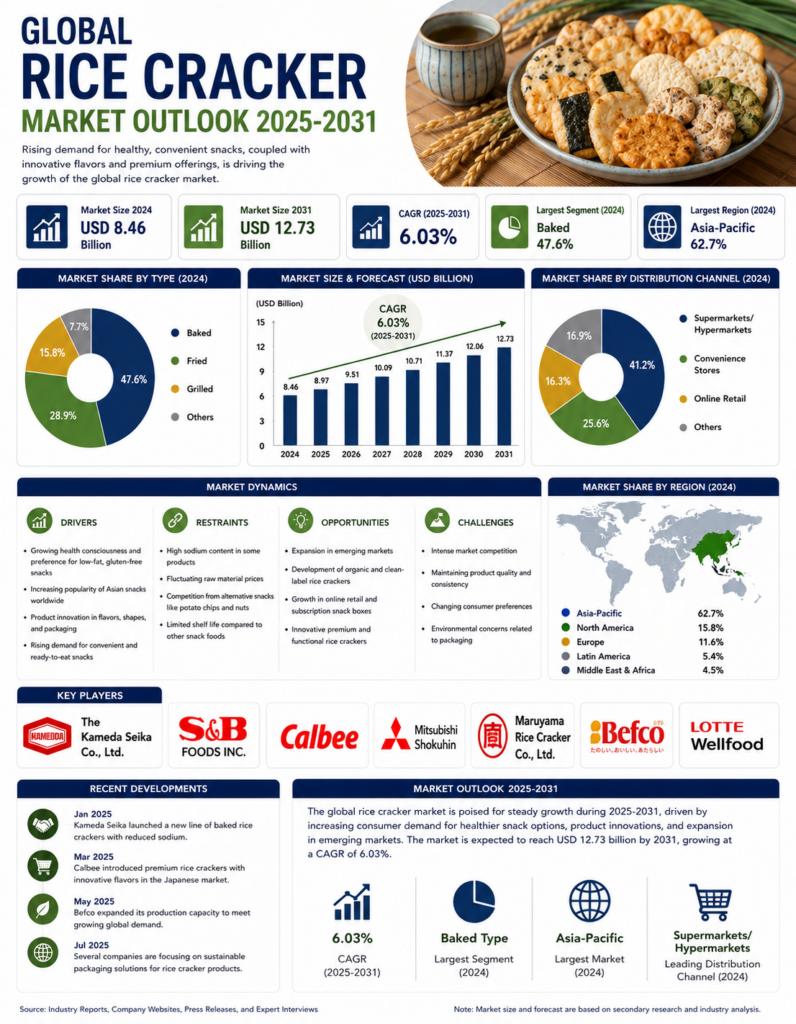
Global Fitness Sandbag Market Outlook 2025-2031 Market Research Point is pleased to present the “Global and Chinese Rice Cracker Market Outlook 2025–2031.” This comprehensive report delivers a well-structured and detailed assessment of the Rice Cracker industry, providing valuable insights into current market conditions, emerging trends, competitive developments, and future growth opportunities… Description Table Of Contents Tables And Figures Research Methodology Market Research Point is pleased to introduce the “Global and Chinese Rice Cracker Market Outlook 2025–2031.” This comprehensive report has been developed to deliver a systematic and detailed assessment of the Rice Cracker industry across both the global and Chinese markets, with particular emphasis on the following key areas: An in-depth review of the current market landscape and emerging development trends shaping the Rice Cracker industry worldwide and in China. Evaluation of the overall size of the global Rice Cracker market, together with a comprehensive analysis of market share across major countries and regions. Assessment of growth opportunities within different Rice Cracker market segments, analysis of downstream demand patterns, and evaluation of the competitive environment. Identification of the primary challenges facing the industry, providing practical insights to help businesses and stakeholders overcome critical market obstacles. This study combines comprehensive secondary research with extensive primary interviews conducted with industry professionals and market participants, ensuring the report delivers accurate, objective, and well-rounded market intelligence. The report presents a detailed analysis of China’s Rice Cracker market, covering production, consumption, imports, and exports. It also profiles leading international and domestic manufacturers operating within the Chinese market, highlighting essential performance indicators including sales volume, revenue, average pricing, gross profit margins, and market share. In addition, the report provides a comprehensive evaluation of the Rice Cracker market by product segment, including detailed analysis by product type, pricing trends, sales performance, revenue generation, and application-specific demand. Historical market data covering 2020–2024 is included alongside market forecasts extending through 2031. Considering the uncertainties arising from the U.S. tariff policy scheduled for implementation in 2025, the report includes a dedicated assessment of its anticipated impact. The analysis explores changes in global and regional competition, international trade relationships, supply chain adjustments, and strategic responses adopted by various countries. It also concludes with strategic recommendations and future market outlooks for participants in the Rice Cracker industry. Leading Global Companies in the Rice Cracker Market:Kameda SeikaSanko SeikaIwatsuka ConfectioneryMochikichiKuriyamabeika (Befco)BourbonBonChiOgurasansouEchigoseikaWant WantUNCLE POPMiduoqiCOFCOXiaowangzi FoodONEONE (Thien Ha Corp)OrionKanom SakolNamchaoOishiXiaoshuaicai Global Rice Cracker Market by Product Type:Non-Glutinous Rice BaseGlutinous Rice Base Global Rice Cracker Market by Application:Supermarkets and HypermarketsIndependent RetailersConvenience StoresOnline RetailersOthers Global Rice Cracker Market by Region:North America (USA and Canada)Europe (Germany, UK, France, Italy, and other European countries)Asia-Pacific (China, Japan, Korea, Taiwan, Southeast Asia, India, and other regional markets)Latin America (Mexico, Brazil, and other countries)Middle East & Africa (Turkey, Saudi Arabia, and other regional markets) I. Rice Cracker Market Overview: 1.1 Product Definition and Market Scope 1.2 Based on product classification, the Rice Cracker market is primarily segmented into:Global Rice Cracker Growth Trend by Product Type (2020 VS 2024 VS 2031)Non-Glutinous Rice BaseGlutinous Rice Base 1.3 Based on end-use applications, the Rice Cracker market is mainly divided into:Global Rice Cracker Growth Trend by Application (2020 VS 2024 VS 2031)Supermarkets and HypermarketsIndependent RetailersConvenience StoresOnline RetailersOthers 1.4 Global Rice Cracker Market Performance and Future Outlook (2020-2031)Global Rice Cracker Market Revenue and Growth Analysis (2020-2031)Global Rice Cracker Sales Volume and Growth Trend (2020-2031) II. Analysis of Leading Global Rice Cracker Manufacturers: 2.1 Global Leading Manufacturers: Rice Cracker Sales and Market ShareGlobal Rice Cracker Sales of Major Manufacturers (2020-2025)Global Rice Cracker Sales Share by Key Manufacturers (2020-2025) 2.2 Global Leading Manufacturers: Revenue and Market ShareGlobal Rice Cracker Revenue of Key Manufacturers (2020-2025)Global Rice Cracker Revenue Share by Major Manufacturers (2020-2025)Global Rice Cracker Revenue Ranking of Leading Manufacturers in 2024 2.3 Global Rice Cracker Average Selling Price by Major Manufacturers (2020-2025) 2.4 Headquarters and Geographic Distribution of Major Global Rice Cracker Manufacturers 2.5 Company Establishment Year and Rice Cracker Commercial Launch Timeline of Key Manufacturers 2.6 Product Portfolio and Application Coverage of Major Global Rice Cracker Manufacturers 2.7 Rice Cracker Market Concentration and Competitive LandscapeGlobal Rice Cracker Market Concentration Analysis: Market Share of Top Five Manufacturers in 2024Global Rice Cracker Market Share by Tier 1, Tier 2, and Tier 3 Manufacturers (Brands) in 2024 2.8 Recent Investments, Business Expansions, and Merger & Acquisition Activities III. Company Profiles of Major Industry Participants: Kameda SeikaSanko SeikaIwatsuka ConfectioneryMochikichiKuriyamabeika (Befco)BourbonBonChiOgurasansouEchigoseikaWant WantUNCLE POPMiduoqiCOFCOXiaowangzi FoodONEONE (Thien Ha Corp)OrionKanom SakolNamchaoOishiXiaoshuaicai Company Overview, Manufacturing Facilities, Headquarters, Competitive Position, and Market Presence. Rice Cracker Product Specifications, Technical Parameters, and Application Portfolio. Global Rice Cracker Sales, Revenue, Average Selling Price, and Gross Margin (2020-2025). Business Overview and Core Operating Segments. Recent Corporate Developments. IV. Analysis by Rice Cracker Product Type: 4.1 Global Rice Cracker Sales by Product Category (2020-2031)Global Rice Cracker Sales and Market Share by Product Type (2020-2025)Global Rice Cracker Sales Forecast by Product Type (2026-2031) 4.2 Global Rice Cracker Market Value by Product Type (2020-2031)Global Rice Cracker Market Size and Share by Product Category (2020-2025)Global Rice Cracker Market Size Forecast by Product Type (2026-2031) 4.3 Global Rice Cracker Price Trend by Product Type (2020-2031) V. Rice Cracker Market Analysis by Application 5.1 Global Rice Cracker Sales by Application (2020-2031)Global Rice Cracker Sales and Market Share by Application (2020-2025)Global Rice Cracker Sales Forecast by Application (2026-2031) 5.2 Global Rice Cracker Market Size and Share by Application (2020-2025)Global Rice Cracker Market Size Forecast by Application (2026-2031) 5.3 Global Rice Cracker Pricing Trend by Application (2020-2031) VI. Industry Development Environment 6.1 Rice Cracker Industry Outlook and Development Trends 6.2 Manufacturer Entry Barriers in the Rice Cracker Industry 6.3 Key Growth Drivers of the Rice Cracker Industry 6.4 Market Challenges and Growth Constraints 6.5 SWOT Assessment of Global Rice Cracker Companies 6.6 Industry Regulations and Policy AnalysisRegulatory Authorities and Industry GovernanceLatest Policy DevelopmentsIndustry Planning and Strategic Direction VII. Rice Cracker Industry Supply Chain Analysis 7.1 Overview of the Rice Cracker Industry Supply Chain7.2 Upstream Industry Analysis7.3 Midstream Industry Analysis7.4 Downstream Industry Analysis7.5 Procurement Strategy in the Rice Cracker Industry7.6 Production
Food & Beverages
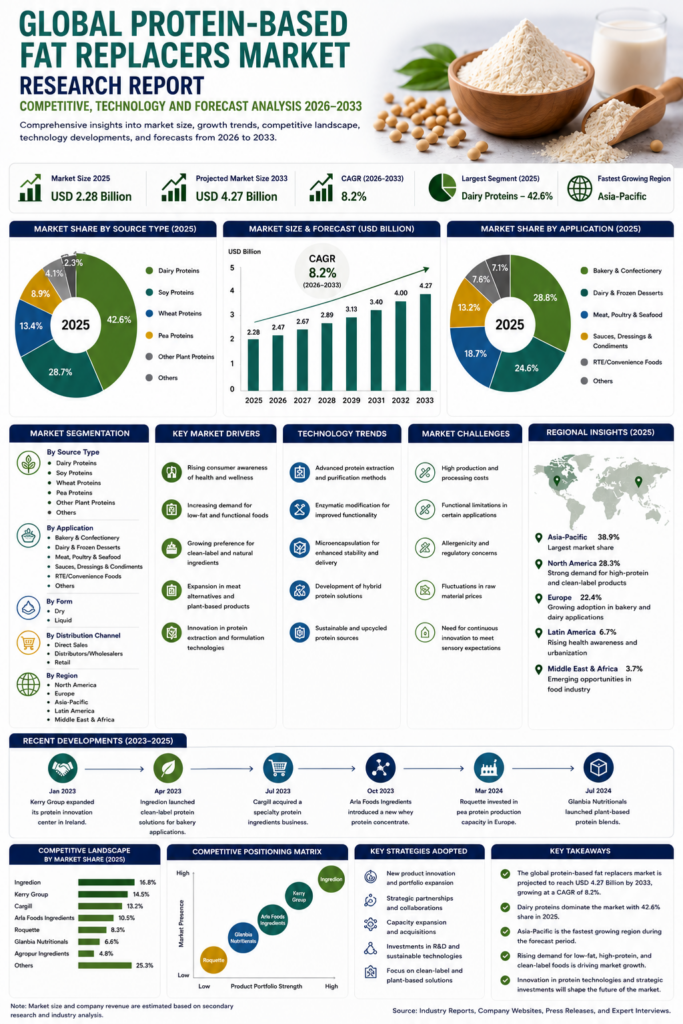
Global Protein-based Fat Replacers Market Research Report, Competitive, Technology and Forecast Analysis 2026-2033 According to the detailed market assessment carried out by Market Research Point, the global Protein-based Fat Replacers market is expected to reach Million USD in 2026 and is forecast to grow to Million USD by 2033, registering a CAGR of % during the 2026–2033 forecast period…. Description Table Of Contents Tables And Figures Research Methodology According to the comprehensive analysis conducted by Market Research Point, the global Protein-based Fat Replacers market is anticipated to reach a value of Million USD in 2026 and is forecast to expand to Million USD by 2033, registering a CAGR of % during the forecast period (2026–2033). The China Protein-based Fat Replacers market, in particular, has experienced notable changes in recent years. By 2026, the Chinese market is projected to reach Million USD, accounting for approximately % of the global market. This report presents an in-depth assessment of the worldwide Protein-based Fat Replacers industry, with dedicated coverage of major economies and the Chinese market. It analyzes historical market performance from 2021 to 2025, considers 2026 as the benchmark year, and provides forecasts for the period from 2027 to 2033. The study thoroughly evaluates the sales performance, pricing trends, shipment volume, revenue generation, gross profit, and market shares of leading manufacturers across key geographic regions while also reviewing their latest strategic initiatives. In addition, it offers detailed segmentation by manufacturer, product category, application, and regional market. The report is designed to help manufacturers, investors, distributors, and new market participants better understand industry trends, demand patterns, and future growth opportunities, enabling well-informed business decisions. From a geographical perspective, the report examines North America, Europe, Asia Pacific, Latin America, and the Middle East & Africa, providing detailed insights into market performance and long-term growth potential across these regions. By considering regional regulations, industry policies, and technological developments, the study highlights the unique characteristics of each market. This regional evaluation enables organizations to better understand competitive dynamics, refine expansion strategies, and strengthen their presence in international markets. The research findings are supported by information gathered from a broad range of reliable and authoritative sources to ensure a solid analytical foundation. Macroeconomic statistics are collected from national statistical agencies and recognized international economic organizations, while industry-specific information is sourced from relevant trade associations. Corporate data is compiled through publicly available resources, executive interviews, and trusted third-party databases. Pricing information is obtained through continuous market monitoring systems. By integrating and validating information from multiple sources, Market Research Point delivers objective, dependable, and forward-looking market intelligence. The report profiles the following companies:CP KelcoParmalat Canada IngredientsCalpro FoodsCargillAshlandAgritech WorldwideFMC CorporationDKSDuPont DaniscoArcher Daniels MidlandTate & LyleKerry GroupSolvaira SpecialtiesBeneo Based on product type, the market is segmented into:Microparticulated ProteinModified Whey Protein ConcentrateOthers Based on application, the report covers the following segments:Dairy ProductsMeat ProductsOthers Key consumption regions analyzed in the report include:USEuropeChinaJapanKoreaIndiaSoutheast AsiaSouth America The report is organized into five major sections consisting of 10 chapters. The content of each section is summarized below: Part One serves as the introductory section and mainly includes Chapter 1, presenting the market overview, product definition, essential concepts, product features, classification by type, key application areas, and the industrial chain structure of the Protein-based Fat Replacers market. Part Two represents the global market analysis and primarily includes Chapters 2–4. This section evaluates worldwide sales volume, market size, segment performance, application analysis, and future growth projections for the global Protein-based Fat Replacers market. Part Three focuses on regional market analysis and includes Chapters 5–6. It provides detailed assessments of sales volume, market value, and future growth prospects across the major regional markets for Protein-based Fat Replacers. Part Four covers the competitive landscape and primarily consists of Chapters 7–8. It analyzes the business profiles of leading global Protein-based Fat Replacers manufacturers, including their product portfolios, technologies, application focus, competitive positioning, sales performance, revenue, market share, and overall industry concentration. Part Five, covering Chapters 9–10, examines the future outlook of the Protein-based Fat Replacers industry. It evaluates the industry’s operating environment, identifies key opportunities and potential risks, and presents future market development prospects to support long-term strategic planning. Market Summary1.1 Product Overview, Applications, and Illustrations1.2 Global Protein-based Fat Replacers Market by Revenue1.2.1 Worldwide Protein-based Fat Replacers Revenue by Product Type1.2.2 Global Protein-based Fat Replacers Revenue Share (%)1.3 Global Protein-based Fat Replacers Market by Production1.3.1 Worldwide Protein-based Fat Replacers Output by Product Type1.3.2 Global Protein-based Fat Replacers Production Share (%) Key Growth Drivers of the Protein-based Fat Replacers Industry2.1 Historical and Forecast Global Protein-based Fat Replacers Demand2.2 Leading Application Segment for Protein-based Fat Replacers (2021-2032)2.3 Major Downstream Enterprises in the China Market, 2026 Global and Regional Market Assessment3.1 Regional Production and Demand Market Size (2026)3.2 Regional Revenue Contribution (2026-2032)3.3 Market Concentration Analysis (CR5 & CR10)3.4 Mergers, Acquisitions, and Capacity Expansion Activities United States Protein-based Fat Replacers Production and Demand (2021-2032)4.1 Production Distribution by Product Type: Historical and Forecast4.2 Demand Distribution by Product Type: Historical and Forecast4.3 Demand Distribution by Application: Historical and Forecast4.4 Revenue Distribution by Product Type (2021-2032)4.5 Revenue Distribution by Application (2021-2032) Europe Protein-based Fat Replacers Production and Demand (2021-2032)5.1 Production Distribution by Product Type: Historical and Forecast5.2 Demand Distribution by Product Type: Historical and Forecast5.3 Demand Distribution by Application: Historical and Forecast5.4 Revenue Distribution by Product Type (2021-2032)5.5 Revenue Distribution by Application (2021-2032) China Protein-based Fat Replacers Production and Demand (2021-2032)6.1 Production Distribution by Product Type: Historical and Forecast6.2 Demand Distribution by Product Type: Historical and Forecast6.3 Demand Distribution by Application: Historical and Forecast6.4 Revenue Distribution by Product Type (2021-2032)6.5 Revenue Distribution by Application (2021-2032) Japan Protein-based Fat Replacers Production and Demand (2021-2032)7.1 Production Distribution by Product Type: Historical and Forecast7.2 Demand Distribution by Product Type: Historical and Forecast7.3 Demand Distribution by Application: Historical and Forecast7.4 Revenue Distribution by Product Type (2021-2032)7.5 Revenue Distribution by Application (2021-2032) India Protein-based Fat Replacers Production and Demand (2021-2032)8.1 Production Distribution by Product Type: Historical and Forecast8.2 Demand Distribution by Product Type: Historical and Forecast8.3 Demand Distribution by Application: Historical and Forecast8.4
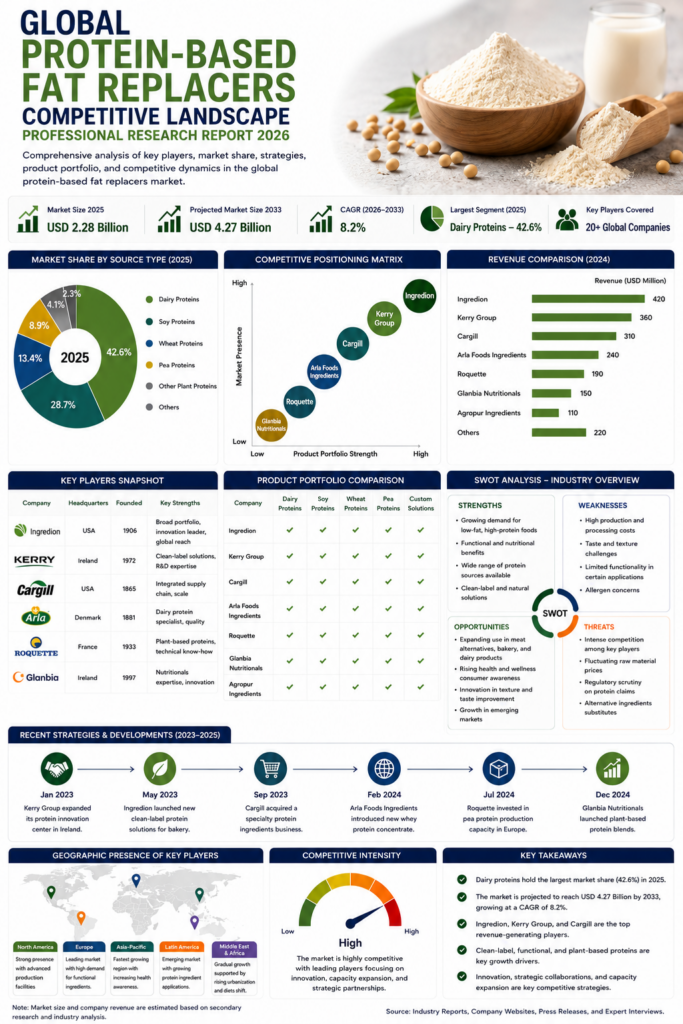
Global Protein-based Fat Replacers Competitive Landscape Professional Research Report 2026 According to comprehensive research conducted by Market Research Point, the global Protein-based Fat Replacers market is expected to reach USD Million in 2026 and is forecast to attain USD Million by 2033, expanding at a CAGR of % during the forecast period (2026–2033)… Description Table Of Contents Tables And Figures Research Methodology According to comprehensive research carried out by Market Research Point, the global Protein-based Fat Replacers market is expected to reach USD Million in 2026 and is projected to attain USD Million by 2033, expanding at a CAGR of % during the forecast period (2026-2033). The China Protein-based Fat Replacers market has undergone notable changes over the past several years. By 2026, the market size in China is forecast to reach USD Million, representing approximately % of the global market. This report offers a comprehensive evaluation of the global Protein-based Fat Replacers industry, with dedicated analysis of major countries and detailed coverage of the Chinese market. It includes historical market data from 2021 to 2025, adopts 2026 as the base year, and provides forecasts for the period from 2027 to 2033. The report systematically analyzes the sales performance, market share, pricing trends, sales volume, revenue, and gross profit of leading global manufacturers across key regions while monitoring their strategic developments. In addition, it presents a comprehensive breakdown of market share by manufacturer, product segment, and application across different geographic markets. The study is intended to help manufacturers, investors, distributors, and prospective market participants gain a clear understanding of demand trends, growth opportunities, and competitive dynamics, supporting effective business planning and strategic decision-making. From a regional perspective, the report covers North America, Europe, Asia Pacific, Latin America, and the Middle East & Africa, providing detailed analysis of current market conditions and future development potential across these important regions. By incorporating the latest technological advancements together with relevant industry regulations and policies, the report highlights the distinctive characteristics influencing each regional market. This regional assessment enables companies to better understand competitive environments, optimize global business strategies, and accelerate their international expansion initiatives. The information presented in this report is compiled from a broad range of reliable and authoritative sources to establish a solid analytical foundation. Macroeconomic data is collected from national statistical agencies and internationally recognized economic organizations, while industry-specific information is obtained from professional trade associations and related institutions. Company information is gathered from publicly available corporate documents, executive interviews, and reputable third-party databases. Pricing information is sourced from comprehensive market monitoring systems. Through the integration and cross-validation of multiple data sources, the report delivers objective analysis, reliable market intelligence, and forward-looking industry insights. The report covers the following companies:CP KelcoParmalat Canada IngredientsCalpro FoodsCargillAshlandAgritech WorldwideFMC CorporationDKSDuPont DaniscoArcher Daniels MidlandTate & LyleKerry GroupSolvaira SpecialtiesBeneo Based on product type, the market is segmented into:Microparticulated ProteinModified Whey Protein ConcentrateOthers Based on application, the report covers the following segments:Dairy ProductsMeat ProductsOthers Major consumption regions covered in the report include:USEuropeChinaJapanKoreaIndiaSoutheast AsiaSouth America The report is organized into five major sections comprising a total of 10 chapters. The primary contents of each section are outlined below: Part One is the Foundation Section, primarily consisting of Chapter 1, which introduces the market overview, fundamental concepts, product definition, key characteristics, product classifications, major application areas, and the industrial chain structure of the Protein-based Fat Replacers market. Part Two is the Global Market Section, covering Chapters 2–4. This section analyzes global sales volume, market size, historical performance, and future growth projections across different product categories and application segments within the Protein-based Fat Replacers market. Part Three is the Regional Market Section, comprising Chapters 5–6. It provides detailed assessments of production, sales volume, market size, and forecast growth across the major regional markets for Protein-based Fat Replacers. Part Four is the Competitive Landscape Section, covering Chapters 7–8. This section profiles the leading global Protein-based Fat Replacers manufacturers, including company overviews, product portfolios, product features, technologies, and application areas. It also evaluates their competitive position through analysis of sales performance, market share, and overall industry concentration. Part Five is the Market Outlook Section, comprising Chapters 9–10. This section examines the industry’s operating environment, emerging growth opportunities, potential risks, and the future development outlook for the global Protein-based Fat Replacers market. Market Summary1.1 Product Overview, Applications, and Illustration1.2 Global Protein-based Fat Replacers Market by Revenue1.2.1 Global Protein-based Fat Replacers Revenue by Product Category1.2.2 Global Protein-based Fat Replacers Revenue Share (%)1.3 Global Protein-based Fat Replacers Market by Production Volume1.3.1 Global Protein-based Fat Replacers Production by Product Category1.3.2 Global Protein-based Fat Replacers Production Share (%) Key Growth Drivers of the Protein-based Fat Replacers Market2.1 Historical and Forecast Global Demand for Protein-based Fat Replacers2.2 Leading Application Segment for Protein-based Fat Replacers (2021-2032)2.3 Major Downstream Companies in the China Market, 2026 Global and Regional Market Analysis3.1 Regional Market Size Based on Production and Demand (2026)3.2 Regional Revenue Share Analysis (2026-2032)3.3 Market Concentration Ratio (CR5 & CR10) for the Protein-based Fat Replacers Market3.4 Mergers, Acquisitions, and Capacity Expansion Plans US Protein-based Fat Replacers Production and Demand (2021-2032)4.1 Historical and Forecast Production Distribution by Product Category4.2 Historical and Forecast Demand Distribution by Product Category4.3 Historical and Forecast Demand Distribution by Application4.4 Historical and Forecast Revenue Distribution by Product Category (2021-2032)4.5 Historical and Forecast Revenue Distribution by Application (2021-2032) Europe Protein-based Fat Replacers Production and Demand (2021-2032)5.1 Historical and Forecast Production Distribution by Product Category5.2 Historical and Forecast Demand Distribution by Product Category5.3 Historical and Forecast Demand Distribution by Application5.4 Historical and Forecast Revenue Distribution by Product Category (2021-2032)5.5 Historical and Forecast Revenue Distribution by Application (2021-2032) China Protein-based Fat Replacers Production and Demand (2021-2032)6.1 Historical and Forecast Production Distribution by Product Category6.2 Historical and Forecast Demand Distribution by Product Category6.3 Historical and Forecast Demand Distribution by Application6.4 Historical and Forecast Revenue Distribution by Product Category (2021-2032)6.5 Historical and Forecast Revenue Distribution by Application (2021-2032) Japan Protein-based Fat Replacers Production and Demand (2021-2032)7.1 Historical and Forecast Production Distribution by Product Category7.2 Historical and Forecast Demand Distribution by Product
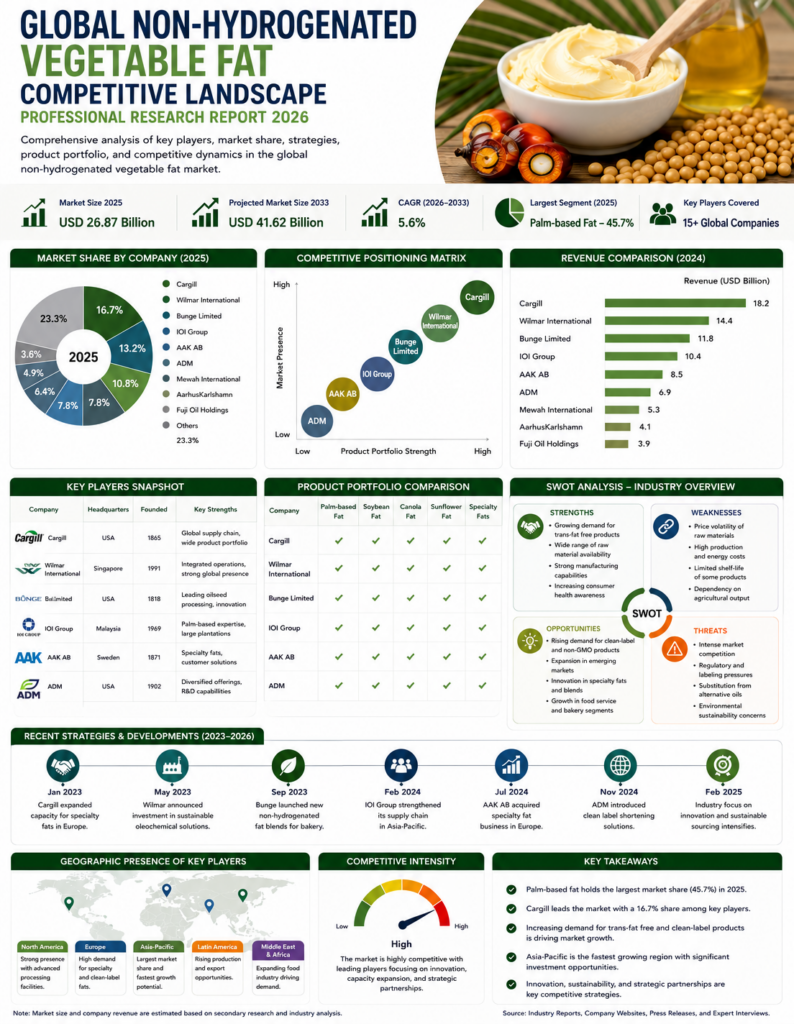
Global Non-hydrogenated Vegetable Fat Competitive Landscape Professional Research Report 2026 According to comprehensive research conducted by Market Research Point, the global Non-hydrogenated Vegetable Fat market is expected to reach USD 277,442 million in 2026 and is forecast to grow to USD 333,324 million by 2033, registering a CAGR of 2.66% during.. Description Table Of Contents Tables And Figures Research Methodology According to an extensive study conducted by Market Research Point, the global Non-hydrogenated Vegetable Fat market is estimated to reach USD 277,442 million in 2026 and is projected to grow to USD 333,324 million by 2033, registering a CAGR of 2.66% during the forecast period (2026-2033). The China Non-hydrogenated Vegetable Fat market has witnessed significant changes over recent years. By 2026, the market size in China is anticipated to reach USD Million, accounting for approximately % of the global market. This report presents a comprehensive assessment of the worldwide Non-hydrogenated Vegetable Fat industry, with particular emphasis on major economies and the Chinese market. It includes historical market statistics covering 2021 to 2025, considers 2026 as the base year, and provides forecasts for the period from 2027 to 2033. The study evaluates the sales performance, market share, pricing trends, sales volume, revenue generation, and gross profit of leading international manufacturers across major geographic regions while monitoring their strategic developments. In addition, it delivers detailed market share analysis by manufacturer, product type, and application across different regions. The report is intended to help manufacturers, investors, distributors, and new market participants better understand market demand, growth opportunities, and competitive trends, supporting well-informed business decisions. From a regional perspective, the report covers North America, Europe, Asia Pacific, Latin America, and the Middle East & Africa, providing detailed evaluations of current market conditions and future growth prospects across these major regions. By combining the latest technological developments with relevant industry regulations and policies, the report highlights the unique characteristics influencing each regional market. This regional analysis enables businesses to understand competitive environments more effectively, optimize international business strategies, and strengthen their global expansion initiatives. The information presented in this report is compiled from a wide range of trusted and authoritative sources to establish a strong analytical foundation. Macroeconomic statistics are obtained from national statistical organizations and internationally recognized economic institutions, while industry-specific information is collected from relevant trade associations and professional organizations. Corporate data is gathered from publicly available company publications, executive interviews, and reputable third-party databases. Pricing information is sourced from comprehensive market monitoring platforms. Through the integration and verification of multiple data sources, the report delivers objective, reliable, and forward-looking market intelligence. The report covers the following companies:CargillArcher Daniels MidlandBungeWilmar InternationalCOFCOMusim MasApicalSime Darby OilsGolden Agri-ResourcesMewah GroupAAKFuji OilVandemoorteleUpfieldIFFCORichardson InternationalOleo-FatsOlenex Based on product type, the market is segmented into:Palm Based FatsLauric Based FatsSoft Seed Oil Based FatsBlended Multi Oil FatsOther Vegetable Fats Based on application, the report covers the following segments:Cooking and Salad OilsFrying Media for FoodserviceShortening Fat for BakeryFilling and Topping FatSpreads and Structured FatsIndustrial and Oleochemical Uses Major consumption regions covered in the report include:USEuropeChinaJapanKoreaIndiaSoutheast AsiaSouth America The report is organized into five major sections covering a total of 10 chapters. The contents of each section are outlined below: Part One is the Market Foundation section, consisting primarily of Chapter 1, which introduces the market overview, product definition, key characteristics, product classifications, major application areas, fundamental concepts, and the industrial chain structure of the Non-hydrogenated Vegetable Fat market. Part Two is the Global Market Analysis section, covering Chapters 2–4. This section analyzes global sales volume, market size, historical performance, and future growth forecasts across different product segments and application categories within the Non-hydrogenated Vegetable Fat market. Part Three is the Regional Market Analysis section, comprising Chapters 5–6. It provides detailed assessments of production, sales volume, market size, and growth projections across the major regional markets for Non-hydrogenated Vegetable Fat. Part Four is the Competitive Landscape section, covering Chapters 7–8. This section profiles leading global Non-hydrogenated Vegetable Fat manufacturers, including company overviews, product portfolios, technologies, product features, and application areas. It also evaluates their competitive positions based on sales performance, market share, and industry concentration. Part Five is the Market Outlook section, including Chapters 9–10. This section examines the overall industry environment, emerging market opportunities, potential risks, and future development prospects for the global Non-hydrogenated Vegetable Fat market. Market Summary1.1 Product Overview, Applications, Images1.2 Global Non-hydrogenated Vegetable Fat Market by Revenue1.2.1 Global Non-hydrogenated Vegetable Fat Revenue by Product Type1.2.2 Global Non-hydrogenated Vegetable Fat Revenue Share (%)1.3 Global Non-hydrogenated Vegetable Fat Market by Production Volume1.3.1 Global Non-hydrogenated Vegetable Fat Production by Product Type1.3.2 Global Non-hydrogenated Vegetable Fat Production Share (%) Key Growth Drivers of the Non-hydrogenated Vegetable Fat Market2.1 Historical and Forecast Global Demand for Non-hydrogenated Vegetable Fat2.2 Leading Application Segment for Non-hydrogenated Vegetable Fat (2021-2032)2.3 Major Downstream Companies in the China Market, 2026 Global and Regional Market Analysis3.1 Regional Market Size Based on Production and Demand (2026)3.2 Regional Revenue Share Analysis (2026-2032)3.3 Market Concentration Analysis (CR5 & CR10) for Non-hydrogenated Vegetable Fat3.4 Mergers, Acquisitions, and Expansion Strategies US Non-hydrogenated Vegetable Fat Production and Demand (2021-2032)4.1 Historical and Forecast Production Distribution by Product Type4.2 Historical and Forecast Demand Distribution by Product Type4.3 Historical and Forecast Demand Distribution by Application4.4 Historical and Forecast Revenue Distribution by Product Type (2021-2032)4.5 Historical and Forecast Revenue Distribution by Application (2021-2032) Europe Non-hydrogenated Vegetable Fat Production and Demand (2021-2032)5.1 Historical and Forecast Production Distribution by Product Type5.2 Historical and Forecast Demand Distribution by Product Type5.3 Historical and Forecast Demand Distribution by Application5.4 Historical and Forecast Revenue Distribution by Product Type (2021-2032)5.5 Historical and Forecast Revenue Distribution by Application (2021-2032) China Non-hydrogenated Vegetable Fat Production and Demand (2021-2032)6.1 Historical and Forecast Production Distribution by Product Type6.2 Historical and Forecast Demand Distribution by Product Type6.3 Historical and Forecast Demand Distribution by Application6.4 Historical and Forecast Revenue Distribution by Product Type (2021-2032)6.5 Historical and Forecast Revenue Distribution by Application (2021-2032) Japan Non-hydrogenated Vegetable Fat Production and Demand (2021-2032)7.1 Historical and Forecast Production Distribution by Product Type7.2 Historical and Forecast Demand Distribution by
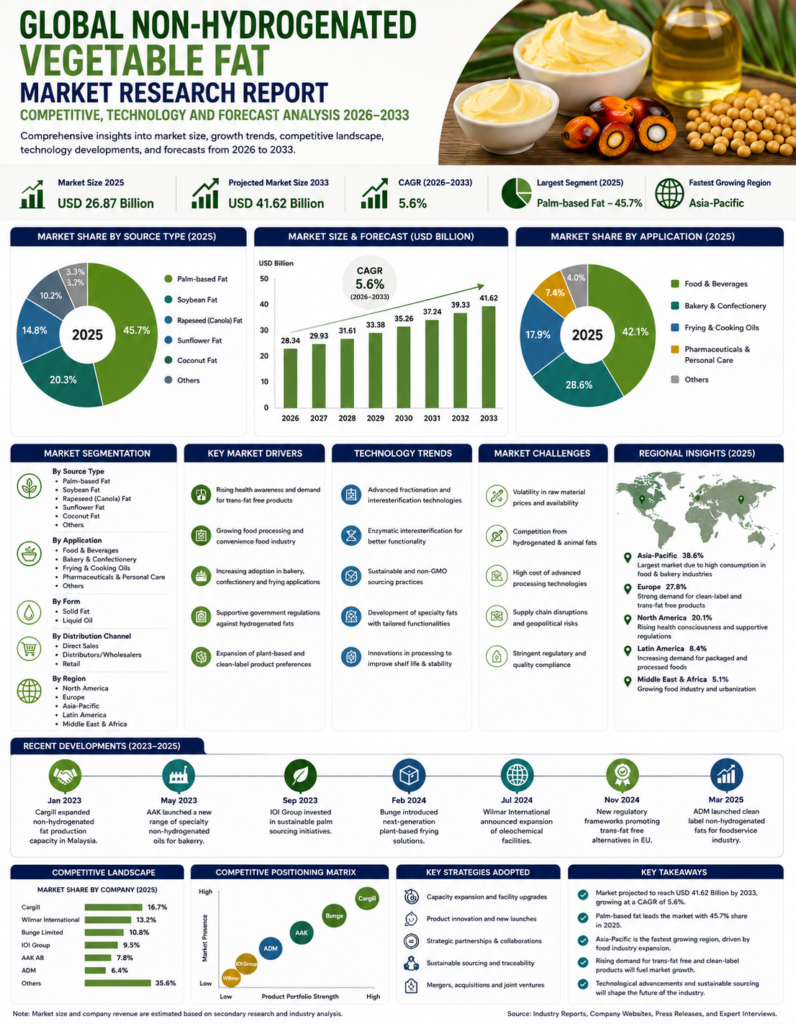
Global Non-hydrogenated Vegetable Fat Market Research Report, Competitive, Technology and Forecast Analysis 2026-2033 According to comprehensive research and analysis conducted by Market Research Point, the global Non-hydrogenated Vegetable Fat market is estimated to reach USD 277,442 million in 2026.. Description Table Of Contents Tables And Figures Research Methodology Based on extensive market evaluation conducted by Market Research Point, the global Non-hydrogenated Vegetable Fat market is anticipated to reach USD 277,442 million in 2026 and is forecast to expand to USD 333,324 million by 2033, progressing at a CAGR of 2.66% throughout the 2026–2033 forecast period. The China Non-hydrogenated Vegetable Fat market has experienced notable transformation over recent years. By 2026, the Chinese market is projected to attain a value of Million USD, accounting for approximately % of the global market. This report delivers a detailed assessment of the worldwide Non-hydrogenated Vegetable Fat industry, with particular emphasis on China and other major international markets. It analyzes historical market performance from 2021 to 2025, adopts 2026 as the base year, and presents forecast estimates covering 2027 through 2033. The study thoroughly evaluates sales volume, revenue generation, pricing trends, gross margins, and market share of leading manufacturers across major regions while reviewing their latest strategic initiatives. In addition, it offers comprehensive segmentation by manufacturer, product category, and application across different geographies. The insights presented are intended to help manufacturers, investors, industry participants, and new entrants better understand market demand, emerging growth opportunities, and competitive developments to support informed business decisions. From a regional perspective, the study examines North America, Europe, Asia Pacific, Latin America, and the Middle East & Africa, providing a comprehensive evaluation of current market conditions and long-term growth prospects across these regions. By incorporating industry regulations, evolving policy frameworks, and recent technological innovations, the report highlights the unique market characteristics of each geography. This regional assessment enables organizations to better understand competitive dynamics, strengthen market positioning, and formulate effective global expansion strategies. The analysis is built upon a broad collection of reliable and verified information sources to ensure dependable market intelligence. Macroeconomic indicators are obtained from official statistical agencies and globally recognized economic organizations, while industry-specific data is sourced from leading trade associations. Company-related information is compiled from publicly available documents, executive interviews, and trusted third-party databases. Pricing insights are derived from dedicated market monitoring platforms. Through rigorous validation and integration of data from multiple sources, Market Research Point delivers an objective, accurate, and forward-looking evaluation of the market. The report profiles the following key companies:CargillArcher Daniels MidlandBungeWilmar InternationalCOFCOMusim MasApicalSime Darby OilsGolden Agri-ResourcesMewah GroupAAKFuji OilVandemoorteleUpfieldIFFCORichardson InternationalOleo-FatsOlenex Based on product type, the market is segmented into:Palm Based FatsLauric Based FatsSoft Seed Oil Based FatsBlended Multi Oil FatsOther Vegetable Fats Based on end-use and application, the market includes:Cooking and Salad OilsFrying Media for FoodserviceShortening Fat for BakeryFilling and Topping FatSpreads and Structured FatsIndustrial and Oleochemical Uses Major consumption regions covered in the report include:USEuropeChinaJapanKoreaIndiaSoutheast AsiaSouth America The report is organized into five major sections across 10 chapters, with the contents outlined below: Part One serves as the introductory section and mainly includes Chapter 1, covering the market overview, fundamental concepts, product definition, product features, key product categories, major application areas, and the industrial chain structure of the Non-hydrogenated Vegetable Fat market. Part Two focuses on the global market and consists of Chapters 2–4. This section analyzes worldwide sales volume, market value, segment performance, application-specific demand, and future growth projections for the Non-hydrogenated Vegetable Fat industry. Part Three presents the regional market assessment through Chapters 5–6, offering detailed analysis of production, consumption, market size, and forecast trends across the principal regional markets for Non-hydrogenated Vegetable Fat. Part Four covers competitive benchmarking in Chapters 7–8. It provides company profiles of leading global Non-hydrogenated Vegetable Fat manufacturers, including their product offerings, technological capabilities, application focus, and strategic developments, along with an evaluation of market share, revenue performance, and industry concentration. Part Five, comprising Chapters 9–10, examines the overall business environment, market opportunities, potential challenges, and industry risks while presenting Market Research Point’s outlook for the future growth and development of the global Non-hydrogenated Vegetable Fat market. Industry Overview1.1 Product Overview, Applications, and Illustrations1.2 Global Non-hydrogenated Vegetable Fat Market by Revenue1.2.1 Worldwide Revenue Analysis by Product Type1.2.2 Revenue Share of the Global Market by Product Type (%)1.3 Global Non-hydrogenated Vegetable Fat Market by Production Volume1.3.1 Worldwide Production Analysis by Product Type1.3.2 Global Production Share by Product Type (%) Key Growth Drivers of the Non-hydrogenated Vegetable Fat Market2.1 Historical Performance and Forecast of Global Demand2.2 Leading Application Segment for Non-hydrogenated Vegetable Fat (2021–2032)2.3 Major Downstream Enterprises in the China Market, 2026 Global and Regional Market Assessment3.1 Regional Production and Demand Market Size Analysis (2026)3.2 Regional Revenue Share Analysis (2026–2032)3.3 Market Concentration Analysis (CR5 & CR10)3.4 Strategic Expansion, Partnerships, and Acquisition Activities United States Non-hydrogenated Vegetable Fat Market: Production and Demand (2021–2032)4.1 Production Distribution by Product Type: Current and Forecast Estimates4.2 Demand Distribution by Product Type: Current and Forecast Estimates4.3 Demand Distribution by Application: Current and Forecast Estimates4.4 Revenue Distribution by Product Type (2021–2032)4.5 Revenue Distribution by Application (2021–2032) Europe Non-hydrogenated Vegetable Fat Market: Production and Demand (2021–2032)5.1 Production Distribution by Product Type: Current and Forecast Estimates5.2 Demand Distribution by Product Type: Current and Forecast Estimates5.3 Demand Distribution by Application: Current and Forecast Estimates5.4 Revenue Distribution by Product Type (2021–2032)5.5 Revenue Distribution by Application (2021–2032) China Non-hydrogenated Vegetable Fat Market: Production and Demand (2021–2032)6.1 Production Distribution by Product Type: Current and Forecast Estimates6.2 Demand Distribution by Product Type: Current and Forecast Estimates6.3 Demand Distribution by Application: Current and Forecast Estimates6.4 Revenue Distribution by Product Type (2021–2032)6.5 Revenue Distribution by Application (2021–2032) Japan Non-hydrogenated Vegetable Fat Market: Production and Demand (2021–2032)7.1 Production Distribution by Product Type: Current and Forecast Estimates7.2 Demand Distribution by Product Type: Current and Forecast Estimates7.3 Demand Distribution by Application: Current and Forecast Estimates7.4 Revenue Distribution by Product Type (2021–2032)7.5 Revenue Distribution by Application (2021–2032) India Non-hydrogenated Vegetable Fat Market: Production and Demand (2021–2032)8.1 Production Distribution by Product Type: Current and Forecast Estimates8.2 Demand Distribution
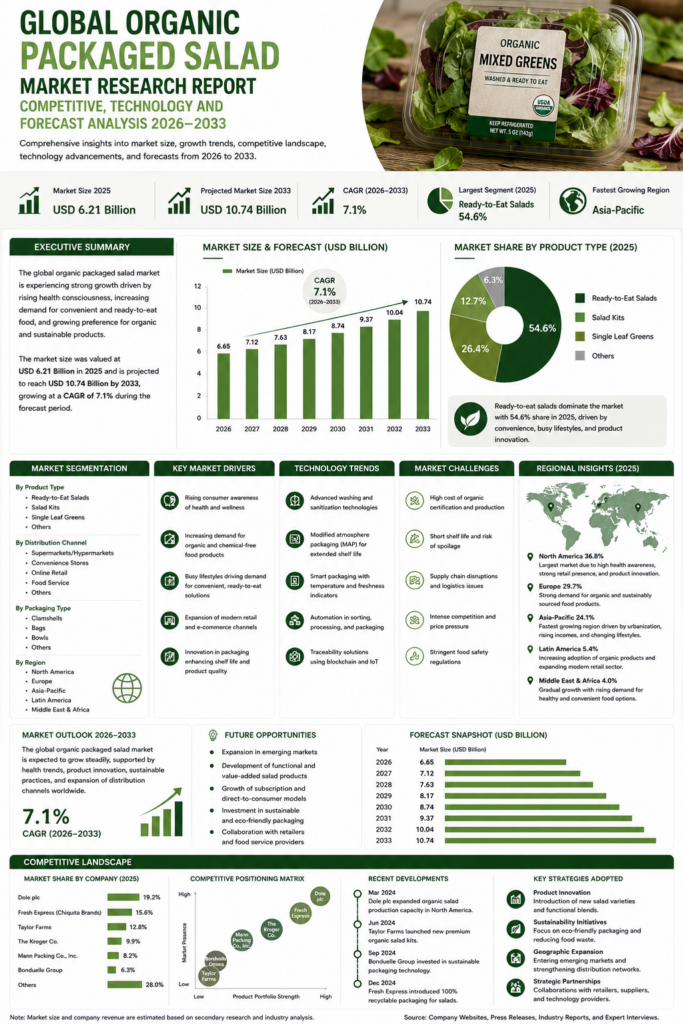
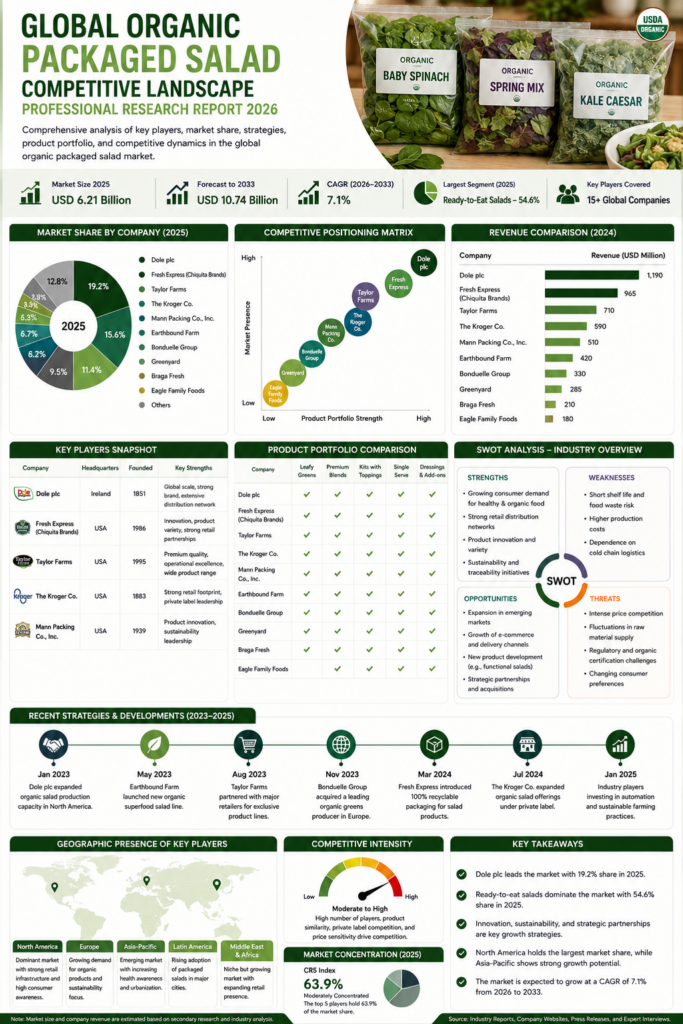
Global Organic Packaged Salad Market Research Report, Competitive, Technology and Forecast Analysis 2026-2033 According to an in-depth study conducted by Market Research Point, the global Organic Packaged Salad market is estimated to reach USD 3,036.84 million in 2026 and is anticipated to grow to USD 5,368.99 million by 2033, registering a compound annual growth rate (CAGR) of 8.48% during the forecast period of 2026–2033. Notably,… Description Table Of Contents Tables And Figures Research Methodology According to an extensive market assessment conducted by Market Research Point, the global Organic Packaged Salad market is estimated to reach USD 3,036.84 million in 2026 and is forecast to expand to USD 5,368.99 million by 2033, registering a CAGR of 8.48% during the forecast period (2026–2033). The Organic Packaged Salad market in China has witnessed notable changes over recent years. By 2026, the Chinese market is projected to reach Million USD, accounting for approximately % of the global market. This report delivers a detailed assessment of the worldwide Organic Packaged Salad industry, with dedicated coverage of major economies and an in-depth evaluation of the Chinese market. It analyzes historical market performance from 2021 to 2025, designates 2026 as the base year, and presents forecasts covering the period from 2027 through 2033. The study comprehensively evaluates sales volume, revenue generation, pricing trends, gross profit, and market share of leading global manufacturers across key geographic regions while monitoring their latest strategic initiatives. In addition, it provides comprehensive segmentation analysis by manufacturer, product type, application, and regional market. The report equips manufacturers, investors, stakeholders, and new entrants with valuable intelligence on market demand, emerging opportunities, and key growth drivers to support informed business planning and strategic decision-making. From a regional perspective, the report examines North America, Europe, Asia Pacific, Latin America, and the Middle East & Africa, delivering a thorough evaluation of existing market conditions together with future growth prospects across these major regions. By incorporating evolving industry regulations, policy developments, and technological innovations, the study highlights the unique characteristics and competitive dynamics of each regional market. This comprehensive regional analysis enables organizations to strengthen their international business strategies and identify opportunities for successful global expansion. The research findings presented in this report are built upon a broad range of trusted and authoritative information sources to establish a reliable analytical framework. Macroeconomic indicators are collected from national statistical organizations and internationally recognized economic institutions, while industry-specific information is obtained through leading trade associations and professional organizations. Company-related data is compiled from publicly available reports, executive interviews, and credible third-party databases, whereas pricing information is sourced from comprehensive market monitoring systems. By integrating and validating information from multiple independent sources, Market Research Point ensures that the report delivers objective, accurate, and forward-looking market intelligence. The report profiles the following companies: Summer FreshSunfreshFresh ExpressGotham GreensBright FarmsEvertasteTaylor FarmsShake SaladVega Mayor SA (Florette)Dole Food CompanyCuration FoodsMisioneroMann PackingBonduelle The report categorizes the market by product type as follows: Fruit SaladVegetable Salad The study evaluates the market across the following application segments: Offline SaleOnline Sale Major regional markets covered include: USEuropeChinaJapanKoreaIndiaSoutheast AsiaSouth America The report is organized into five major sections encompassing a total of 10 chapters. The primary contents are summarized below: Part One serves as the introductory section and mainly includes Chapter 1, presenting the market overview, key terminology, product definition, product characteristics, major product categories, principal application areas, and the Organic Packaged Salad industry value chain. Part Two represents the global market analysis and includes Chapters 2–4. This section examines worldwide sales volume, market value, segment-wise performance, application analysis, and forecast trends for the global Organic Packaged Salad market. Part Three focuses on regional market evaluation and consists of Chapters 5–6. It provides detailed assessments of production, sales volume, market size, and future growth projections across the leading regional markets for Organic Packaged Salad. Part Four contains the competitive and corporate analysis covered in Chapters 7–8. It presents detailed company profiles of major Organic Packaged Salad manufacturers, including their product offerings, technological capabilities, product features, application areas, sales performance, revenue generation, market share, and overall industry concentration, along with an assessment of the competitive environment. Part Five comprises Chapters 9–10 and explores the future outlook of the Organic Packaged Salad industry. It evaluates the industry’s operating environment, identifies major growth opportunities and potential risks, and presents forward-looking insights into future market development and long-term industry prospects. Figure 1. Application-wise Demand Distribution for the Organic Packaged Salad Market (Volume)Figure 2. Regional Organic Packaged Salad Production and Consumption Analysis, 2026Figure 3. Revenue Share by Region (2026 & 2032)Figure 4. Revenue Share of the Top 10 and Top 5 Market Participants in 2026Figure 5. United States Organic Packaged Salad Production and Demand (2021–2032)Figure 6. Production Share by Product Type (%)Figure 7. Demand Distribution by Product Type (%)Figure 8. Demand Distribution by Application (%)Figure 9. Revenue Contribution by Product Type (%)Figure 10. Revenue Contribution by Application (%)Figure 11. Europe Organic Packaged Salad Production and Demand (2021–2032)Figure 12. Production Share by Product Type (%)Figure 13. Demand Distribution by Product Type (%)Figure 14. Demand Distribution by Application (%)Figure 15. Revenue Contribution by Product Type (%)Figure 16. Revenue Contribution by Application (%)Figure 17. China Organic Packaged Salad Production and Demand (2021–2032)Figure 18. Production Share by Product Type (%)Figure 19. Demand Distribution by Product Type (%)Figure 20. Demand Distribution by Application (%)Figure 21. Revenue Contribution by Product Type (%)Figure 22. Revenue Contribution by Application (%)Figure 23. Japan Organic Packaged Salad Production and Demand (2021–2032)Figure 24. Production Share by Product Type (%)Figure 25. Demand Distribution by Product Type (%)Figure 26. Demand Distribution by Application (%)Figure 27. Revenue Contribution by Product Type (%)Figure 28. Revenue Contribution by Application (%)Figure 29. India Organic Packaged Salad Production and Demand (2021–2032)Figure 30. Production Share by Product Type (%)Figure 31. Demand Distribution by Product Type (%)Figure 32. Demand Distribution by Application (%)Figure 33. Revenue Contribution by Product Type (%)Figure 34. Revenue Contribution by Application (%)Figure 35. South Korea Organic Packaged Salad Production and Demand (2021–2032)Figure 36. Production Share by Product Type (%)Figure 37. Demand
Global Organic Packaged Salad Competitive Landscape Professional Research Report 2026 According to the comprehensive market analysis conducted by Market Research Point, the global Organic Packaged Salad market is estimated to be valued at USD 3,036.84 million in 2026… Description Table Of Contents Tables And Figures Research Methodology According to the extensive research and market assessment conducted by Market Research Point, the global Organic Packaged Salad market is estimated to reach USD 3,036.84 million in 2026 and is projected to grow to USD 5,368.99 million by 2033, expanding at a CAGR of 8.48% during the forecast period (2026–2033). The China Organic Packaged Salad market has experienced significant transformation in recent years. By 2026, the Chinese market is anticipated to reach Million USD, accounting for approximately % of the global market share. This report delivers a detailed evaluation of the worldwide Organic Packaged Salad market, with particular emphasis on China and other major regional markets. It reviews historical market performance from 2021 to 2025, establishes 2026 as the base year, and presents forecasts covering the period from 2027 through 2033. The study thoroughly analyzes the sales performance, revenue generation, market share, pricing trends, sales volume, and gross profit of leading companies across key geographic regions while also examining their latest strategic initiatives. In addition, it provides comprehensive market segmentation by manufacturer, product type, application, and region, enabling businesses, investors, and new entrants to better understand market dynamics, growth opportunities, and competitive developments for informed decision-making. From a regional perspective, the report analyzes North America, Europe, Asia Pacific, Latin America, and the Middle East & Africa, providing detailed insights into market performance, growth potential, and emerging opportunities across these regions. By incorporating current industry regulations, evolving consumer preferences, and recent technological innovations, the report highlights the unique characteristics of each regional market. These insights help organizations strengthen their competitive positioning, refine international expansion strategies, and capitalize on regional growth opportunities. The research findings presented in this report are supported by a broad range of credible and verified information sources. Macroeconomic indicators are compiled from national statistical agencies and internationally recognized economic institutions, while industry-specific data is collected from trade associations and professional organizations. Company-related information is sourced from publicly available disclosures, executive interviews, and trusted third-party databases. Pricing information is obtained through comprehensive market monitoring systems. By integrating and validating information from multiple reliable sources, Market Research Point ensures the report delivers objective analysis, dependable forecasts, and actionable market intelligence. The report profiles the following key companies: Summer FreshSunfreshFresh ExpressGotham GreensBright FarmsEvertasteTaylor FarmsShake SaladVega Mayor SA (Florette)Dole Food CompanyCuration FoodsMisioneroMann PackingBonduelle Based on product type, the market is segmented into the following categories: Fruit SaladVegetable Salad Based on application, the report covers the following market segments: Offline SaleOnline Sale Major consumption regions analyzed in this report include: USEuropeChinaJapanKoreaIndiaSoutheast AsiaSouth America The report is organized into five major sections consisting of 10 chapters. The contents of each section are summarized below: Part One serves as the introductory section and primarily includes Chapter 1, presenting the market overview, industry background, product definition, key characteristics, product classifications, major application areas, and the overall industrial chain structure of the Organic Packaged Salad market. Part Two represents the global market analysis and includes Chapters 2–4. This section examines worldwide sales volume, market value, segment performance, application analysis, and future market growth forecasts for the Organic Packaged Salad industry. Part Three focuses on regional market analysis through Chapters 5–6. It provides detailed assessments of sales volume, market size, and future growth prospects across the major regional markets for Organic Packaged Salad. Part Four covers competitive landscape analysis in Chapters 7–8. It presents comprehensive profiles of leading Organic Packaged Salad manufacturers, including company overviews, product portfolios, technological capabilities, application coverage, sales performance, revenue analysis, market share evaluation, and overall industry concentration. Part Five concludes the report with Chapters 9–10, offering an assessment of the industry’s operating environment, emerging opportunities, market challenges, potential risks, and long-term development outlook, helping stakeholders identify future growth prospects within the global Organic Packaged Salad market. Market Summary1.1 Product Overview, Applications, and Illustrations1.2 Global Organic Packaged Salad Market Analysis by Revenue1.2.1 Worldwide Organic Packaged Salad Revenue by Product Type1.2.2 Revenue Share of the Global Organic Packaged Salad Market (%)1.3 Global Organic Packaged Salad Market Analysis by Production1.3.1 Worldwide Organic Packaged Salad Production by Product Type1.3.2 Production Share of the Global Organic Packaged Salad Market (%) Key Growth Factors of the Organic Packaged Salad Industry2.1 Historical and Forecast Global Demand for Organic Packaged Salad2.2 Leading Application Segment for Organic Packaged Salad (2021-2032)2.3 Major Downstream Enterprises in the China Market (2026) Global and Regional Market Analysis3.1 Regional Market Size Based on Production and Demand (2026)3.2 Regional Revenue Share Analysis (2026-2032)3.3 Market Concentration Analysis (CR5 & CR10) for Organic Packaged Salad3.4 Mergers, Acquisitions, and Capacity Expansion Strategies United States Organic Packaged Salad Production and Demand (2021-2032)4.1 Current and Projected Production by Product Type4.2 Current and Projected Demand by Product Type4.3 Current and Projected Demand by Application4.4 Current and Projected Revenue by Product Type (2021-2032)4.5 Current and Projected Revenue by Application (2021-2032) Europe Organic Packaged Salad Production and Demand (2021-2032)5.1 Current and Projected Production by Product Type5.2 Current and Projected Demand by Product Type5.3 Current and Projected Demand by Application5.4 Current and Projected Revenue by Product Type (2021-2032)5.5 Current and Projected Revenue by Application (2021-2032) China Organic Packaged Salad Production and Demand (2021-2032)6.1 Current and Projected Production by Product Type6.2 Current and Projected Demand by Product Type6.3 Current and Projected Demand by Application6.4 Current and Projected Revenue by Product Type (2021-2032)6.5 Current and Projected Revenue by Application (2021-2032) Japan Organic Packaged Salad Production and Demand (2021-2032)7.1 Current and Projected Production by Product Type7.2 Current and Projected Demand by Product Type7.3 Current and Projected Demand by Application7.4 Current and Projected Revenue by Product Type (2021-2032)7.5 Current and Projected Revenue by Application (2021-2032) India Organic Packaged Salad Production and Demand (2021-2032)8.1 Current and Projected Production by Product Type8.2 Current and Projected Demand by Product Type8.3 Current and Projected Demand by Application8.4
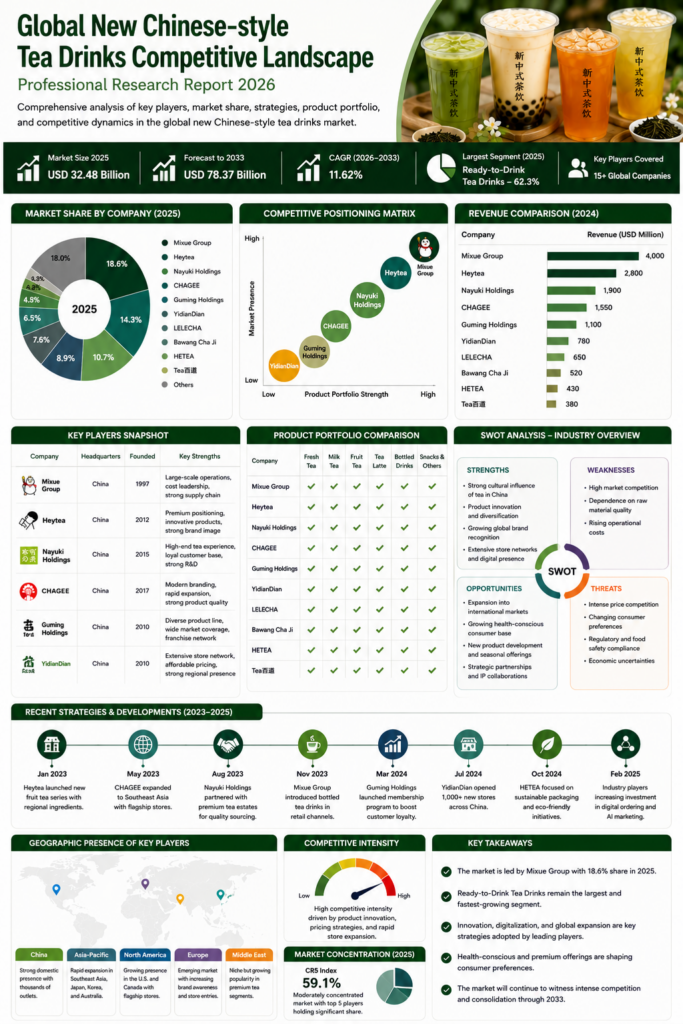
Global New Chinese-style Tea Drinks Competitive Landscape Professional Research Report 2026 According to comprehensive research and analysis conducted by Market Research Point, the global New Chinese-style Tea Drinks market is estimated to reach USD 56,053 million in 2026 and is forecast to grow to USD 92,500 million by 2033, registering a CAGR of 7.42% .. Description Table Of Contents Tables And Figures Research Methodology According to extensive research conducted by Market Research Point, the global New Chinese-style Tea Drinks market is estimated to reach USD 56,053 million in 2026 and is anticipated to grow to USD 92,500 million by 2033, registering a CAGR of 7.42% during the forecast period of 2026–2033. The China New Chinese-style Tea Drinks market has witnessed significant transformation in recent years. By 2026, the market size in China is projected to reach Million USD, accounting for approximately % of the global market. This report delivers a detailed assessment of the worldwide New Chinese-style Tea Drinks market, with particular emphasis on the Chinese market and other major economies. It presents historical market performance from 2021 to 2025, adopts 2026 as the base year, and provides forecasts covering 2027 to 2033. The study evaluates leading manufacturers based on sales volume, revenue, pricing, gross profit, and market share across key regions while monitoring their latest business strategies and competitive developments. In addition, it offers comprehensive segmentation by manufacturer, product type, application, and geography, enabling businesses, investors, and new market participants to better understand market demand, competitive dynamics, and future growth opportunities for informed decision-making. From a regional perspective, the report examines North America, Europe, Asia-Pacific, Latin America, and the Middle East & Africa, providing comprehensive insights into current market conditions and long-term growth potential. By assessing regional industry policies, economic trends, and technological advancements, the report highlights the distinctive characteristics of each market. These insights help organizations evaluate regional opportunities, strengthen competitive positioning, and formulate effective global expansion strategies. The analysis presented in this report is supported by information gathered from a broad range of reliable and authoritative sources. Macroeconomic indicators are obtained from national statistical agencies and international economic organizations, while industry-specific information is collected from trade associations and sector publications. Company-related data is compiled from public disclosures, executive interviews, and trusted third-party databases, whereas pricing information is sourced through extensive market monitoring. By integrating and validating data from multiple channels, Market Research Point ensures that the report delivers objective, dependable, and forward-looking market intelligence. The report profiles the following companies:HeyteaShenzhen Pindao Restaurant ManagementAuntea JennnyCoCo Fresh Tea & JuiceYihetangChabaidaoShuyisxcZhengzhou Mixue BingchengDAKASIAlittle-teaSexyteaPeachful Based on product type, the market is segmented into:Milk TeaFruit Tea Based on application, the market is categorized into:Online SalesOffline Sales Key consumption regions covered in the report include:USEuropeChinaJapanKoreaIndiaSoutheast AsiaSouth America The report is organized into five major sections encompassing ten chapters, structured as follows: Part One serves as the introductory section and primarily includes Chapter 1, presenting the market overview, fundamental concepts, product definition, key characteristics, product classifications, major application areas, and the industry chain analysis of the New Chinese-style Tea Drinks market. Part Two represents the global market analysis and includes Chapters 2–4. This section evaluates worldwide sales volume, market value, segment performance, application analysis, and future growth projections for the New Chinese-style Tea Drinks industry. Part Three focuses on regional market assessment through Chapters 5–6, providing detailed analysis of sales performance, market size, and forecast trends across major geographic markets for New Chinese-style Tea Drinks. Part Four contains the competitive landscape analysis in Chapters 7–8. It examines the business profiles of leading global manufacturers, including their product portfolios, technological capabilities, product features, application focus, sales performance, revenue generation, market share, and overall competitive positioning within the industry. Part Five, consisting of Chapters 9–10, evaluates the overall business environment, emerging opportunities, potential risks, and future development outlook of the global New Chinese-style Tea Drinks industry, offering strategic insights into the market’s long-term growth prospects under the Market Research Point research framework. Market Overview1.1 Product Overview, Applications, and Product Images1.2 Global Organic Frozen Salmon Market by Revenue1.2.1 Global Organic Frozen Salmon Revenue by Product Type1.2.2 Global Organic Frozen Salmon Revenue Share by Product Type (%)1.3 Global Organic Frozen Salmon Market by Production1.3.1 Global Organic Frozen Salmon Production by Product Type1.3.2 Global Organic Frozen Salmon Production Share by Product Type (%) Key Growth Drivers of the Organic Frozen Salmon Industry2.1 Historical and Forecast Global Organic Frozen Salmon Demand2.2 Leading Application Segment for Organic Frozen Salmon (2021–2032)2.3 Major Downstream Enterprises in the China Market, 2026 Global and Regional Market Analysis3.1 Regional Market Size Based on Production and Demand (2026)3.2 Regional Market Revenue Share (2026–2032)3.3 Market Concentration Analysis (CR5 & CR10)3.4 Mergers, Acquisitions, and Capacity Expansion Strategies United States Organic Frozen Salmon Production and Demand (2021–2032)4.1 Current and Forecast Production Distribution by Product Type4.2 Current and Forecast Demand Distribution by Product Type4.3 Current and Forecast Demand Distribution by Application4.4 Current and Forecast Revenue Distribution by Product Type (2021–2032)4.5 Current and Forecast Revenue Distribution by Application (2021–2032) Europe Organic Frozen Salmon Production and Demand (2021–2032)5.1 Current and Forecast Production Distribution by Product Type5.2 Current and Forecast Demand Distribution by Product Type5.3 Current and Forecast Demand Distribution by Application5.4 Current and Forecast Revenue Distribution by Product Type (2021–2032)5.5 Current and Forecast Revenue Distribution by Application (2021–2032) China Organic Frozen Salmon Production and Demand (2021–2032)6.1 Current and Forecast Production Distribution by Product Type6.2 Current and Forecast Demand Distribution by Product Type6.3 Current and Forecast Demand Distribution by Application6.4 Current and Forecast Revenue Distribution by Product Type (2021–2032)6.5 Current and Forecast Revenue Distribution by Application (2021–2032) Japan Organic Frozen Salmon Production and Demand (2021–2032)7.1 Current and Forecast Production Distribution by Product Type7.2 Current and Forecast Demand Distribution by Product Type7.3 Current and Forecast Demand Distribution by Application7.4 Current and Forecast Revenue Distribution by Product Type (2021–2032)7.5 Current and Forecast Revenue Distribution by Application (2021–2032) India Organic Frozen Salmon Production and Demand (2021–2032)8.1 Current and Forecast Production Distribution by Product Type8.2 Current and Forecast Demand Distribution by Product Type8.3 Current and Forecast Demand
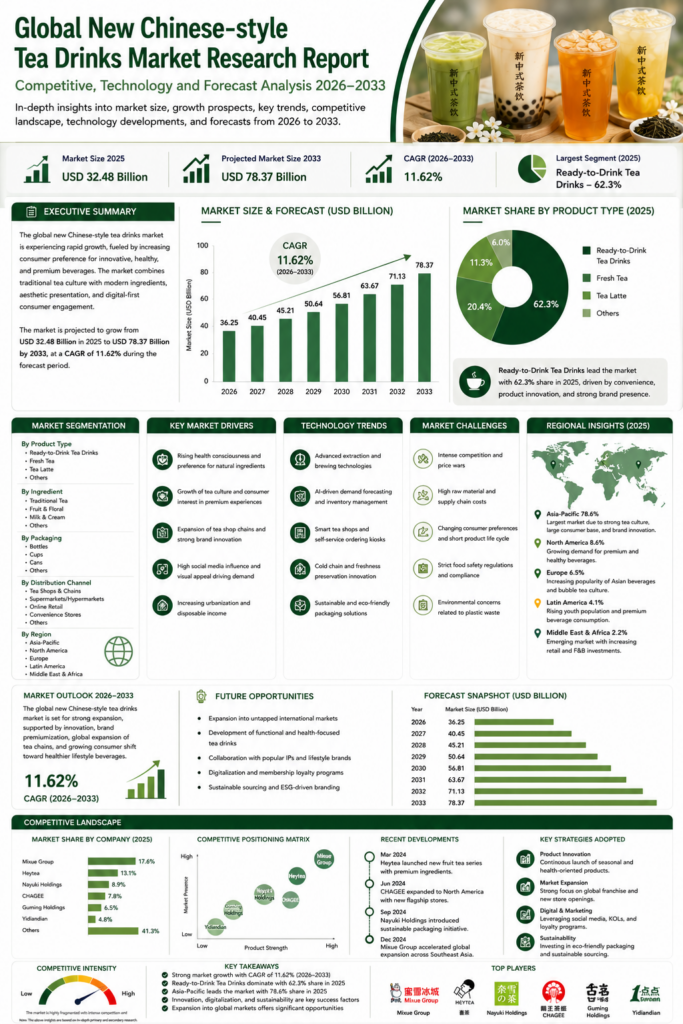
Global New Chinese-style Tea Drinks Market Research Report, Competitive, Technology and Forecast Analysis 2026-2033 According to comprehensive research and detailed market analysis conducted by Market Research Point, the global New Chinese-style Tea Drinks market is estimated to reach USD 56,053 million in 2026.. Description Table Of Contents Tables And Figures Research Methodology According to comprehensive market research conducted by Market Research Point, the global New Chinese-style Tea Drinks market is expected to reach USD 56,053 million in 2026 and is forecast to grow to USD 92,500 million by 2033, expanding at a CAGR of 7.42% during the forecast period of 2026–2033. China continues to be one of the most influential markets for New Chinese-style Tea Drinks, experiencing rapid development over recent years. By 2026, the Chinese market is projected to achieve a value of Million USD, accounting for approximately % of the global market. This report delivers an in-depth assessment of the worldwide New Chinese-style Tea Drinks market, with dedicated analysis of China alongside other major international markets. It reviews historical market performance from 2021 through 2025, adopts 2026 as the base year, and provides forecasts covering the period from 2027 to 2033. The study evaluates revenue generation, sales volume, pricing trends, gross margins, and market share of leading manufacturers across key regions while tracking their strategic initiatives and business developments. In addition, the report presents a comprehensive segmentation analysis by manufacturer, product category, application, and geography, enabling businesses, investors, and new market participants to better understand demand patterns, growth opportunities, and competitive positioning for informed strategic planning. From a regional perspective, the study covers North America, Europe, Asia-Pacific, Latin America, and the Middle East & Africa, providing detailed insights into market size, regional performance, and future development potential. By incorporating regional regulations, consumer trends, technological advancements, and industry policies, the report highlights the unique characteristics shaping each geographic market. These insights help organizations refine their international expansion strategies and strengthen their competitive presence across diverse regional markets. The analysis presented in this report is supported by information gathered from a broad range of credible and authoritative sources. Macroeconomic indicators are compiled from national statistical agencies and internationally recognized economic institutions, while industry-specific information is obtained through trade associations and professional organizations. Company-related data is collected from publicly available disclosures, executive interviews, and trusted third-party databases, whereas pricing information is sourced from comprehensive market monitoring platforms. Through extensive cross-validation and integration of multiple datasets, Market Research Point ensures the report delivers reliable, objective, and forward-looking market intelligence. The report profiles the following companies: HeyteaShenzhen Pindao Restaurant ManagementAuntea JennnyCoCo Fresh Tea & JuiceYihetangChabaidaoShuyisxcZhengzhou Mixue BingchengDAKASIAlittle-teaSexyteaPeachful Based on product type, the market is segmented into: Milk TeaFruit Tea Based on sales channel, the report covers: Online SalesOffline Sales Major consumption regions covered include: USEuropeChinaJapanKoreaIndiaSoutheast AsiaSouth America The report is organized into five major sections across ten chapters, structured as follows: Part One: Foundation Section, primarily including Chapter 1, introduces the New Chinese-style Tea Drinks market by covering market background, product definition, key characteristics, product classifications, primary application areas, and the overall industry value chain. Part Two: Global Market Analysis, comprising Chapters 2–4, examines worldwide sales volume, market value, segment performance, and growth forecasts across different product categories and application areas. Part Three: Regional Market Analysis, including Chapters 5–6, presents detailed evaluations of production, consumption, market size, and future growth prospects across the major regional markets for New Chinese-style Tea Drinks. Part Four: Competitive Landscape Analysis, covering Chapters 7–8, provides comprehensive company profiles of leading global manufacturers, including their product portfolios, technological capabilities, application focus, sales performance, revenue generation, market shares, and overall competitive positioning within the global industry. Part Five: Market Outlook, comprising Chapters 9–10, evaluates the industry’s operating environment, emerging opportunities, potential risks, and long-term growth outlook, offering strategic insights into the future direction of the global New Chinese-style Tea Drinks market. Market Summary1.1 Product Overview, Applications, and Illustrations1.2 Global New Chinese-style Tea Drinks Market by Revenue1.2.1 Worldwide Revenue by Product Category1.2.2 Revenue Share by Product Category (%)1.3 Global New Chinese-style Tea Drinks Market by Production Volume1.3.1 Worldwide Production by Product Category1.3.2 Production Share by Product Category (%) Key Growth Drivers of the New Chinese-style Tea Drinks Industry2.1 Historical Analysis and Forecast of Global Demand2.2 Leading Application Segment for New Chinese-style Tea Drinks (2021-2032)2.3 Major Downstream Enterprises in the China Market (2026) Global and Regional Market Assessment3.1 Regional Production and Demand Analysis (2026)3.2 Regional Revenue Share Analysis (2026-2032)3.3 Market Concentration Ratio (CR5 & CR10) Analysis3.4 Mergers, Acquisitions, and Expansion Strategies United States New Chinese-style Tea Drinks Production and Demand (2021-2032)4.1 Current and Forecast Production Distribution by Product Type4.2 Current and Forecast Demand Distribution by Product Type4.3 Current and Forecast Demand Distribution by Application4.4 Current and Forecast Revenue Distribution by Product Type (2021-2032)4.5 Current and Forecast Revenue Distribution by Application (2021-2032) Europe New Chinese-style Tea Drinks Production and Demand (2021-2032)5.1 Current and Forecast Production Distribution by Product Type5.2 Current and Forecast Demand Distribution by Product Type5.3 Current and Forecast Demand Distribution by Application5.4 Current and Forecast Revenue Distribution by Product Type (2021-2032)5.5 Current and Forecast Revenue Distribution by Application (2021-2032) China New Chinese-style Tea Drinks Production and Demand (2021-2032)6.1 Current and Forecast Production Distribution by Product Type6.2 Current and Forecast Demand Distribution by Product Type6.3 Current and Forecast Demand Distribution by Application6.4 Current and Forecast Revenue Distribution by Product Type (2021-2032)6.5 Current and Forecast Revenue Distribution by Application (2021-2032) Japan New Chinese-style Tea Drinks Production and Demand (2021-2032)7.1 Current and Forecast Production Distribution by Product Type7.2 Current and Forecast Demand Distribution by Product Type7.3 Current and Forecast Demand Distribution by Application7.4 Current and Forecast Revenue Distribution by Product Type (2021-2032)7.5 Current and Forecast Revenue Distribution by Application (2021-2032) India New Chinese-style Tea Drinks Production and Demand (2021-2032)8.1 Current and Forecast Production Distribution by Product Type8.2 Current and Forecast Demand Distribution by Product Type8.3 Current and Forecast Demand Distribution by Application8.4 Current and Forecast Revenue Distribution by Product Type (2021-2032)8.5 Current and Forecast Revenue Distribution by Application (2021-2032) South Korea New Chinese-style
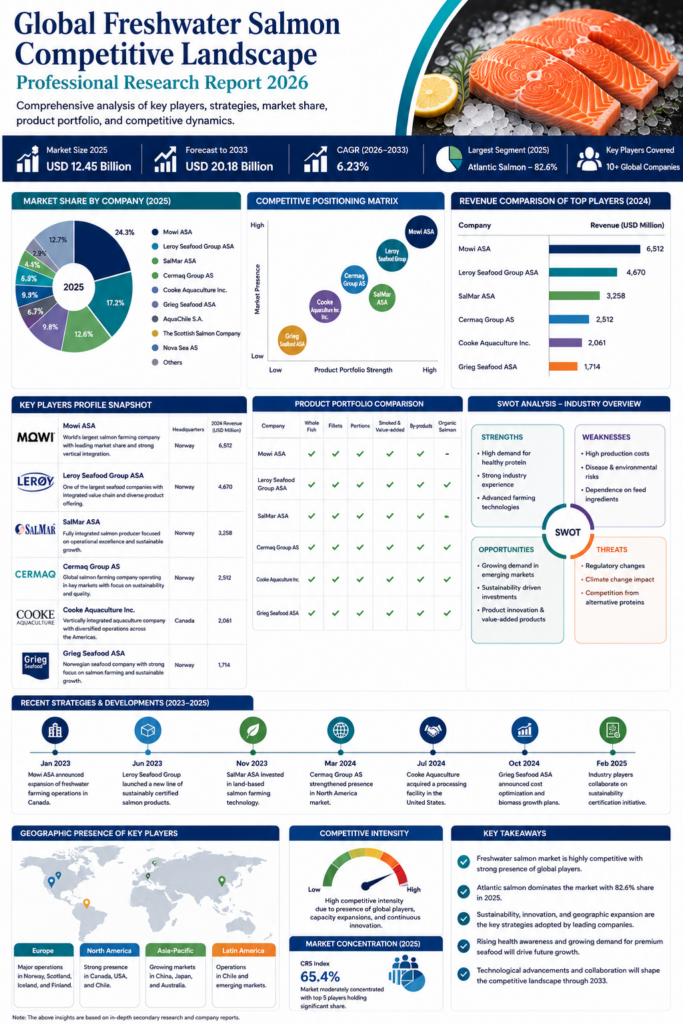
Global Freshwater Salmon Competitive Landscape Professional Research Report 2026 According to the latest comprehensive study conducted by Market Research Point, the global Freshwater Salmon market is estimated to reach USD 813.41 million in 2026 and is forecast to attain USD 1,405.93 million by 2033, expanding at a CAGR of 8.13% during the forecast… Description Table Of Contents Tables And Figures Research Methodology According to the latest in-depth market assessment conducted by Market Research Point, the global Freshwater Salmon market is anticipated to reach USD 813.41 million in 2026 and is projected to grow to USD 1,405.93 million by 2033, registering a CAGR of 8.13% during the forecast period from 2026 to 2033. Among regional markets, China has experienced particularly rapid development in recent years. By 2026, the Freshwater Salmon market in China is expected to reach Million USD, accounting for approximately % of the global market share. This report offers a comprehensive analysis of the worldwide Freshwater Salmon market, with detailed coverage of major international markets and dedicated insights into China. It includes historical market statistics from 2021 to 2025, adopts 2026 as the base year, and presents market forecasts extending from 2027 through 2033. The study thoroughly evaluates sales performance, market share, pricing trends, shipment volume, revenue generation, and gross profit of leading manufacturers across key geographic regions while monitoring their strategic business developments. In addition, the report delivers an extensive assessment of market shares by manufacturer, product type, application, and region, enabling businesses, investors, and new entrants to better understand evolving demand patterns, competitive positioning, and future growth opportunities for strategic decision-making. From a geographical perspective, the report examines North America, Europe, Asia-Pacific, Latin America, and the Middle East & Africa, providing a detailed assessment of market performance, regional trends, and future growth prospects across these major territories. By incorporating the latest industry regulations, technological advancements, and policy developments, the report highlights the unique characteristics of each regional market. These insights enable companies to refine their competitive strategies, strengthen regional market positioning, and support long-term international expansion initiatives. The analysis presented in this report is supported by a broad range of reliable and authoritative information sources to ensure maximum credibility and analytical precision. Macroeconomic indicators are collected from national statistical agencies and internationally recognized economic organizations, while industry-specific information is obtained through leading trade associations and professional institutions. Company-level intelligence is gathered from publicly available corporate disclosures, executive interviews, and trusted third-party databases. Market pricing information is compiled through comprehensive monitoring systems. By integrating and validating multiple independent data sources, Market Research Point delivers objective, reliable, and forward-looking market intelligence. The report profiles the following leading companies: SalMar ASMowi ASACermaqCooke AquacultureLerøy Seafood GroupFlakstadvåg Laks AS (Brødrene Karlsen Holding AS)The Irish Organic Salmon CompanyHiddenfjordVisscher SeafoodAquaChile (Agrosuper)Mannin Bay Salmon LimitedVilla Seafood ASCURRAUN FISHERIES LIMITEDBradán Beo TeoJCS FishCreative SalmonGlenarm Organic SalmonHuon Aqua (JBS Foods)Scottish Salmon CompanyOrganic Sea HarvestLoch Duart Ltd.Petuna SeafoodsHuon AquacultureGrieg SeafoodVital ChoiceQingdao Conson Oceantec Valley Development Co., Ltd. (Qingdao Guoxin Development (Group) Co., Ltd.)Shandong Deep Sea Green Breeding Co., Ltd. (Rizhao Wanzefeng Fisheries Co., Ltd.) The market is segmented by product type as follows: Organic Atlantic SalmonOrganic Coho SalmonOrganic Sockeye SalmonOrganic Pink SalmonOthers Based on application, the market is categorized into the following segments: Food Service SectorRetail Sector The report analyzes demand across the following key consumption regions: USEuropeChinaJapanKoreaIndiaSoutheast AsiaSouth America The report is organized into five major sections comprising a total of 10 chapters, structured as follows: Part One serves as the introductory section and mainly includes Chapter 1, presenting the overall market overview, fundamental concepts, product definitions, key product characteristics, product segmentation, major application areas, and the industrial value chain of the Freshwater Salmon market. Part Two focuses on the global market and includes Chapters 2 through 4. This section evaluates worldwide sales volume, market size, demand trends, segment performance, and future growth projections across different product categories and application segments. Part Three presents the regional market analysis and consists of Chapters 5 and 6. It provides comprehensive assessments of production, demand, market size, and growth forecasts for the major regional Freshwater Salmon markets worldwide. Part Four covers the competitive landscape through Chapters 7 and 8. This section profiles the leading global Freshwater Salmon manufacturers, examining their corporate background, product portfolio, technologies, product features, and application coverage. It also evaluates their competitive position based on sales performance, revenue generation, market share, and overall industry concentration. Part Five concludes the report with Chapters 9 and 10, providing a detailed assessment of the market environment, emerging business opportunities, potential industry risks, and the future development outlook for the global Freshwater Salmon market. Market Summary1.1 Product Overview, Applications, and Illustrations1.2 Global Freshwater Salmon Market Size by Revenue1.2.1 Worldwide Freshwater Salmon Revenue by Product Type1.2.2 Revenue Share of the Global Freshwater Salmon Market (%)1.3 Global Freshwater Salmon Market by Output1.3.1 Worldwide Freshwater Salmon Production by Product Type1.3.2 Production Share of the Global Freshwater Salmon Market (%) Key Growth Drivers of the Freshwater Salmon Market2.1 Historical and Forecast Global Freshwater Salmon Demand2.2 Leading Application Segment for Freshwater Salmon (2021–2032)2.3 Major Downstream Enterprises in the China Market, 2026 Global and Regional Market Assessment3.1 Regional Production and Demand Market Size (2026)3.2 Regional Revenue Share Analysis (2026–2032)3.3 Market Concentration Analysis (CR5 & CR10) for Freshwater Salmon3.4 Mergers, Acquisitions, and Capacity Expansion Strategies United States Freshwater Salmon Production and Demand (2021–2032)4.1 Production Distribution by Product Type: Current and Forecast4.2 Demand Distribution by Product Type: Current and Forecast4.3 Demand Distribution by Application: Current and Forecast4.4 Revenue Distribution by Product Type (2021–2032)4.5 Revenue Distribution by Application (2021–2032) Europe Freshwater Salmon Production and Demand (2021–2032)5.1 Production Distribution by Product Type: Current and Forecast5.2 Demand Distribution by Product Type: Current and Forecast5.3 Demand Distribution by Application: Current and Forecast5.4 Revenue Distribution by Product Type (2021–2032)5.5 Revenue Distribution by Application (2021–2032) China Freshwater Salmon Production and Demand (2021–2032)6.1 Production Distribution by Product Type: Current and Forecast6.2 Demand Distribution by Product Type: Current and Forecast6.3 Demand Distribution by Application: Current and Forecast6.4 Revenue Distribution by Product Type (2021–2032)6.5 Revenue Distribution by