

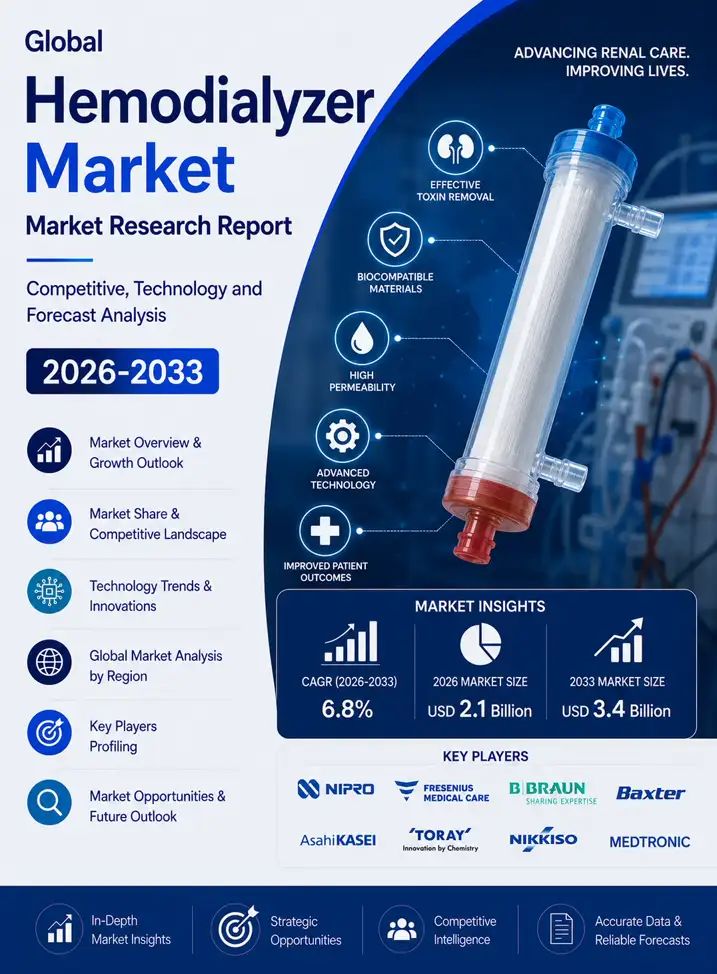
According to Market Research Point’s in-depth investigation and research, the Hemodialyzer market size will reach 1,599.72 Million USD in 2026 and is projected to reach 2,660.93 Million USD by 2033, with a CAGR of 7.54% (2026-2033). Notably, the China Hemodialyzer market has experienced significant changes in recent years. By 2026, the China market size is expected to reach Million USD, accounting for approximately % of the global market share.
This report provides a comprehensive overview of the global Hemodialyzer industry, with a particular focus on major countries and the Chinese market. It presents historical data from 2021 to 2025, uses 2026 as the base year, and provides market forecasts for the period from 2027 to 2033. The report offers a detailed analysis of revenue, sales volume, pricing, market share, and gross profit of leading companies across key regions while tracking their strategic developments. It also examines market share by manufacturer, product type, and application across different regions. The report is designed to help businesses, investors, and new market entrants better understand market demand, competitive dynamics, and future growth opportunities, supporting informed strategic decision-making.
Geographically, the report covers North America, Europe, Asia Pacific, Latin America, and the Middle East & Africa, providing an in-depth assessment of market performance and future growth prospects across these regions. By incorporating the latest industry policies, technological developments, and regional market trends, the report highlights the unique characteristics and competitive landscape of each market. These insights enable companies to optimize their business strategies and strengthen their global market presence.
The analysis presented in this report is based on information collected from a wide range of reliable and authoritative sources. Macroeconomic statistics are obtained from national statistical agencies and international economic organizations, while industry-specific data is collected from trade associations and professional institutions. Company information is gathered through publicly available sources, interviews, and trusted third-party databases. Pricing information is derived from comprehensive market monitoring systems. By integrating and cross-verifying these diverse data sources, Market Research Point ensures the accuracy, objectivity, and reliability of its market analysis.
The report covers the following companies:
Fresenius
MEDICA
Farmasol
Nipro
Baxter International
Asahi Kasei Medical
Allmed Medical
Medivators
Kawasumi
Johnson Matthey
Bain Medical
WEGO
Lengthen
Peony-medical
Chengdu OCI Medical Devices
SanXin Medical
Based on product type, the market is segmented into the following categories:
High Throughput
Low Throughput
Based on application, the report covers the following segments:
Hospital
Laboratory
Others
Major consumption regions covered in the report include:
US
Europe
China
Japan
Korea
India
Southeast Asia
South America
This report is organized into five major sections comprising ten chapters.
Part One is the Foundational Section, primarily including Chapter 1, which introduces the market overview, product definition, key characteristics, product classifications, major application areas, and the industrial chain structure of the Hemodialyzer market.
Part Two is the Global Section, primarily including Chapters 2–4, which analyze global sales volume, market size, market share, and growth forecasts across different product types and application segments.
Part Three is the Regional Section, primarily including Chapters 5–6, which examine sales volume, market size, market share, and future growth trends across the major regional markets for Hemodialyzer.
Part Four is the Corporate Analysis Section, primarily including Chapters 7–8, which profiles the leading global companies operating in the Hemodialyzer market. This section evaluates their product portfolios, technologies, applications, strategic developments, sales performance, revenue, market share, and competitive positioning.
Part Five is the Outlook Section, comprising Chapters 9–10, which evaluates the industry’s operating environment, key growth opportunities, market challenges, and potential risks while presenting the future outlook for the global Hemodialyzer market.
Market Overview
1.1 Product Introduction, Applications, and Product Image
1.2 Global Hemodialyzer Market by Revenue
1.2.1 Global Hemodialyzer Revenue by Product Type
1.2.2 Global Hemodialyzer Revenue Market Share by Product Type (%)
1.3 Global Hemodialyzer Market by Production
1.3.1 Global Hemodialyzer Production by Product Type
1.3.2 Global Hemodialyzer Production Share by Product Type (%)Market Drivers and Industry Analysis
2.1 Historical and Forecast Global Hemodialyzer Demand
2.2 Leading Application Segment for Hemodialyzer (2021–2032)
2.3 Major Downstream Companies in the China Market (2026)Global and Regional Market Analysis
3.1 Regional Market Size by Production and Demand (2026)
3.2 Regional Revenue Market Share (2026–2032)
3.3 Market Concentration Ratio (CR5 & CR10)
3.4 Mergers, Acquisitions, and Expansion StrategiesUnited States Hemodialyzer Market (2021–2032)
4.1 Production Analysis by Product Type
4.2 Demand Analysis by Product Type
4.3 Demand Analysis by Application
4.4 Revenue Analysis by Product Type (2021–2032)
4.5 Revenue Analysis by Application (2021–2032)Europe Hemodialyzer Market (2021–2032)
5.1 Production Analysis by Product Type
5.2 Demand Analysis by Product Type
5.3 Demand Analysis by Application
5.4 Revenue Analysis by Product Type (2021–2032)
5.5 Revenue Analysis by Application (2021–2032)China Hemodialyzer Market (2021–2032)
6.1 Production Analysis by Product Type
6.2 Demand Analysis by Product Type
6.3 Demand Analysis by Application
6.4 Revenue Analysis by Product Type (2021–2032)
6.5 Revenue Analysis by Application (2021–2032)Japan Hemodialyzer Market (2021–2032)
7.1 Production Analysis by Product Type
7.2 Demand Analysis by Product Type
7.3 Demand Analysis by Application
7.4 Revenue Analysis by Product Type (2021–2032)
7.5 Revenue Analysis by Application (2021–2032)India Hemodialyzer Market (2021–2032)
8.1 Production Analysis by Product Type
8.2 Demand Analysis by Product Type
8.3 Demand Analysis by Application
8.4 Revenue Analysis by Product Type (2021–2032)
8.5 Revenue Analysis by Application (2021–2032)Korea Hemodialyzer Market (2021–2032)
9.1 Production Analysis by Product Type
9.2 Demand Analysis by Product Type
9.3 Demand Analysis by Application
9.4 Revenue Analysis by Product Type (2021–2032)
9.5 Revenue Analysis by Application (2021–2032)Southeast Asia Hemodialyzer Market (2021–2032)
10.1 Production Analysis by Product Type
10.2 Demand Analysis by Product Type
10.3 Demand Analysis by Application
10.4 Revenue Analysis by Product Type (2021–2032)
10.5 Revenue Analysis by Application (2021–2032)South America Hemodialyzer Market (2021–2032)
11.1 Production Analysis by Product Type
11.2 Demand Analysis by Product Type
11.3 Demand Analysis by Application
11.4 Revenue Analysis by Product Type (2021–2032)
11.5 Revenue Analysis by Application (2021–2032)Global Hemodialyzer Average Price Trend
13.1 Average Market Price by Product Type in the US (2021–2026)
13.2 Average Market Price by Product Type in Europe (2021–2026)
13.3 Average Market Price by Product Type in China (2021–2026)
13.4 Average Market Price by Product Type in Japan (2021–2026)
13.5 Average Market Price by Product Type in India (2021–2026)
13.6 Average Market Price by Product Type in Korea (2021–2026)
13.7 Average Market Price by Product Type in Southeast Asia (2021–2026)Industry Value Chain Analysis
14.1 Hemodialyzer Industry Value Chain Analysis
14.2 Downstream Industry Analysis
14.3 Technology Development TrendsCompetitive Landscape
15.1 Fresenius
15.1.1 Company Profile
15.1.2 Product Overview
15.1.3 Hemodialyzer Sales and Revenue
15.1.4 Strategic Developments
15.2 MEDICA
15.2.1 Company Profile
15.2.2 Product Overview
15.2.3 Hemodialyzer Sales and Revenue
15.2.4 Strategic Developments
15.3 Farmasol
15.3.1 Company Profile
15.3.2 Product Overview
15.3.3 Hemodialyzer Sales and Revenue
15.3.4 Strategic Developments
15.4 Nipro
15.4.1 Company Profile
15.4.2 Product Overview
15.4.3 Hemodialyzer Sales and Revenue
15.4.4 Strategic Developments
15.5 Baxter International
15.5.1 Company Profile
15.5.2 Product Overview
15.5.3 Hemodialyzer Sales and Revenue
15.5.4 Strategic Developments
15.6 Asahi Kasei Medical
15.6.1 Company Profile
15.6.2 Product Overview
15.6.3 Hemodialyzer Sales and Revenue
15.6.4 Strategic Developments
15.7 Allmed Medical
15.7.1 Company Profile
15.7.2 Product Overview
15.7.3 Hemodialyzer Sales and Revenue
15.7.4 Strategic Developments
15.8 Medivators
15.8.1 Company Profile
15.8.2 Product Overview
15.8.3 Hemodialyzer Sales and Revenue
15.8.4 Strategic Developments
15.9 Kawasumi
15.10 Johnson Matthey
15.11 Bain Medical
15.12 WEGO
15.13 Lengthen
15.14 Peony-medical
Figure 1. Total Hemodialyzer Demand by Application (Volume)
Figure 2. Hemodialyzer Production and Demand by Region (2026)
Figure 3. Regional Revenue Market Share (2026 & 2032)
Figure 4. Market Share of the Top 5 and Top 10 Companies by Revenue (2026)
Figure 5. United States Hemodialyzer Production and Demand (2021–2032)
Figure 6. Production Breakdown by Product Type (%)
Figure 7. Demand Breakdown by Product Type (%)
Figure 8. Demand Breakdown by Application (%)
Figure 9. Revenue Breakdown by Product Type (%)
Figure 10. Revenue Breakdown by Application (%)
Figure 11. Europe Hemodialyzer Production and Demand (2021–2032)
Figure 12. Production Breakdown by Product Type (%)
Figure 13. Demand Breakdown by Product Type (%)
Figure 14. Demand Breakdown by Application (%)
Figure 15. Revenue Breakdown by Product Type (%)
Figure 16. Revenue Breakdown by Application (%)
Figure 17. China Hemodialyzer Production and Demand (2021–2032)
Figure 18. Production Breakdown by Product Type (%)
Figure 19. Demand Breakdown by Product Type (%)
Figure 20. Demand Breakdown by Application (%)
Figure 21. Revenue Breakdown by Product Type (%)
Figure 22. Revenue Breakdown by Application (%)
Figure 23. Japan Hemodialyzer Production and Demand (2021–2032)
Figure 24. Production Breakdown by Product Type (%)
Figure 25. Demand Breakdown by Product Type (%)
Figure 26. Demand Breakdown by Application (%)
Figure 27. Revenue Breakdown by Product Type (%)
Figure 28. Revenue Breakdown by Application (%)
Figure 29. India Hemodialyzer Production and Demand (2021–2032)
Figure 30. Production Breakdown by Product Type (%)
Figure 31. Demand Breakdown by Product Type (%)
Figure 32. Demand Breakdown by Application (%)
Figure 33. Revenue Breakdown by Product Type (%)
Figure 34. Revenue Breakdown by Application (%)
Figure 35. Korea Hemodialyzer Production and Demand (2021–2032)
Figure 36. Production Breakdown by Product Type (%)
Figure 37. Demand Breakdown by Product Type (%)
Figure 38. Demand Breakdown by Application (%)
Figure 39. Revenue Breakdown by Product Type (%)
Figure 40. Revenue Breakdown by Application (%)
Figure 41. Southeast Asia Hemodialyzer Production and Demand (2021–2032)
Figure 42. Production Breakdown by Product Type (%)
Figure 43. Demand Breakdown by Product Type (%)
Figure 44. Demand Breakdown by Application (%)
Figure 45. Revenue Breakdown by Product Type (%)
Figure 46. Revenue Breakdown by Application (%)
Figure 47. South America Hemodialyzer Production and Demand (2021–2032)
Figure 48. Production Breakdown by Product Type (%)
Figure 49. Demand Breakdown by Product Type (%)
Figure 50. Demand Breakdown by Application (%)
Figure 51. Revenue Breakdown by Product Type (%)
Figure 52. Revenue Breakdown by Application (%)
Figure 53. Hemodialyzer Industry Value Chain
Table 1. Leading Manufacturers and Market Segmentation
Table 2. Product Introduction, Applications, and Product Image
Table 3. Hemodialyzer Revenue by Product Type (Million USD), 2021–2032
Table 4. Hemodialyzer Production by Product Type, 2021–2032
Table 5. Hemodialyzer Demand by Application, 2021–2032
Table 6. Hemodialyzer Revenue by Application (Million USD), 2021–2032
Table 7. Major Downstream Companies in China
Table 8. Regional Market Share by Production and Demand (2026)
Table 9. Regional Revenue Market Share (2026 & 2032)
Table 10. Ranking of Global Leading Hemodialyzer Companies by Revenue and Market Concentration Ratio (2026)
Table 11. Mergers, Acquisitions, and Expansion Strategies
Table 12. United States Hemodialyzer Production, Revenue (Million USD), and Demand (2021–2032)
Table 13. Production Breakdown by Product Type (2021–2032)
Table 14. Demand Breakdown by Product Type (2021–2032)
Table 15. Demand Breakdown by Application (2021–2032)
Table 16. Revenue Breakdown by Product Type
Table 17. Revenue Breakdown by Application
Table 18. Europe Hemodialyzer Production, Revenue (Million USD), and Demand (2021–2032)
Table 19. Production Breakdown by Product Type (2021–2032)
Table 20. Demand Breakdown by Product Type (2021–2032)
Table 21. Demand Breakdown by Application (2021–2032)
Table 22. Revenue Breakdown by Product Type
Table 23. Revenue Breakdown by Application
Table 24. China Hemodialyzer Production, Revenue (Million USD), and Demand (2021–2032)
Table 25. Production Breakdown by Product Type (2021–2032)
Table 26. Demand Breakdown by Product Type (2021–2032)
Table 27. Demand Breakdown by Application (2021–2032)
Table 28. Revenue Breakdown by Product Type
Table 29. Revenue Breakdown by Application
Table 30. Japan Hemodialyzer Production, Revenue (Million USD), and Demand (2021–2032)
Table 31. Production Breakdown by Product Type (2021–2032)
Table 32. Demand Breakdown by Product Type (2021–2032)
Table 33. Demand Breakdown by Application (2021–2032)
Table 34. Revenue Breakdown by Product Type
Table 35. Revenue Breakdown by Application
Table 36. India Hemodialyzer Production, Revenue (Million USD), and Demand (2021–2032)
Table 37. Production Breakdown by Product Type (2021–2032)
Table 38. Demand Breakdown by Product Type (2021–2032)
Table 39. Demand Breakdown by Application (2021–2032)
Table 40. Revenue Breakdown by Product Type
Table 41. Revenue Breakdown by Application
Table 42. Korea Hemodialyzer Production, Revenue (Million USD), and Demand (2021–2032)
Table 43. Production Breakdown by Product Type (2021–2032)
Table 44. Demand Breakdown by Product Type (2021–2032)
Table 45. Demand Breakdown by Application (2021–2032)
Table 46. Revenue Breakdown by Product Type
Table 47. Revenue Breakdown by Application
Table 48. Southeast Asia Hemodialyzer Production, Revenue (Million USD), and Demand (2021–2032)
Table 49. Production Breakdown by Product Type (2021–2032)
Table 50. Demand Breakdown by Product Type (2021–2032)
Table 51. Demand Breakdown by Application (2021–2032)
Table 52. Revenue Breakdown by Product Type
Table 53. Revenue Breakdown by Application
Table 54. South America Hemodialyzer Production, Revenue (Million USD), and Demand (2021–2032)
Table 55. Production Breakdown by Product Type (2021–2032)
Table 56. Demand Breakdown by Product Type (2021–2032)
Table 57. Demand Breakdown by Application (2021–2032)
Table 58. Revenue Breakdown by Product Type
Table 59. Revenue Breakdown by Application
Table 60. Average Market Price by Product Type in the United States (2021–2026)
Table 61. Average Market Price by Product Type in Europe (2021–2026)
Table 62. Average Market Price by Product Type in China (2021–2026)
Table 63. Average Market Price by Product Type in Japan (2021–2026)
Table 64. Average Market Price by Product Type in India (2021–2026)
The research methodology employed by Market Research Point has been developed through a series of rigorous procedures to ensure the quality, reliability, and accuracy of the data presented in our reports. Our analysts are employed full-time and undergo extensive professional training for more than six months to meet the high research standards maintained by Market Research Point. The research methodology can be divided into five stages.
Stage 1: Secondary research
The research team begins by reviewing industry magazines, trade journals, government publications, company reports, and other reliable sources relevant to the target market. Information collected through our in-house research database provides a strong foundation for further analysis. Leveraging industry expertise and extensive research experience, our analysts carefully extract, verify, and organize accurate information from these secondary sources.
Stage 2: Primary research: Interviews with industry participants
Following the secondary research phase, our analysts conduct a large number of interviews through telephone calls, online meetings, and direct discussions with key industry participants. These interviews include leading manufacturers, suppliers, distributors, importers, wholesalers, installers, service providers, industry experts, and end users. The insights gathered through primary research are thoroughly validated and cross-checked against the findings obtained during the secondary research stage.
Stage 3: Data analysis and validation
The research team consolidates and analyzes all information collected during the first two stages. Statistical models, market analysis techniques, and expert evaluations are used to verify the consistency and reliability of the data. Where necessary, additional interviews are conducted to validate key findings and ensure maximum accuracy.
Stage 4: Quantitative market assessment
Market Research Point develops quantitative market estimates, including market size, production capacity, revenue forecasts, growth projections, and investment analysis based on the validated data collected during the previous stages. In addition to quantitative analysis, our research team provides detailed market insights, trend analysis, and strategic evaluations, making each report a comprehensive and unique source of market intelligence.
Stage 5: Quality control
Before publication, every report undergoes a comprehensive quality review and editorial process conducted by our experienced management and research teams. Each report is carefully checked for consistency, accuracy, and completeness. Continuous analyst training and an established internal quality management system ensure that every report published by Market Research Point meets the highest standards of research excellence.